Showing posts with label Hume. Show all posts

Tuesday, 2 March 2010

Nietzsche on the Neighbour; Hume on Sympathy

It seems to me that Nietzsche’s comments on the neighbour could be taken as comments on Hume’s view of sympathy in moral philosophy. I have placed a shortened version of aphorism 146 from Dawn at the bottom of this post, which I think is paticularly pertinent.

This is not a question of Hume directly influencing Nietzsche, or of Nietzsche consciously reflecting on Hume. As far as I know, Nietzsche did not read Hume and he certainly not discuss his texts. However, he was concerned with ‘English psychologists’ (On the Genealogy of Morality, Essay I, mentioned explicitly in 1 and discussed from 1 to 3) and had an idea of Hume’s ideas from their influence on German Idealist philosophy, Schopenhauer’s references, and the work of his friend Paul Rée. He refers to Rée’s book 0f 1877 in The Origin of the Moral Sensations in the Genealogy (Preface, 4).

The point is that I am arguing that there is something to be gained from thinking about some passages in Nietzsche’s as if they were polemical comments on Hume. Discussion of the ‘Neighbour’ are particularly relevant here. Nietzsche takes a critical view of the relation of ‘neighbour’ and implications he finds in it of dependence and herd existence. In particular, in this passage from Dawn, he questions the value of concerning ourselves with the suffering of the neighbour. Our automatic reaction to the pain and pleasures of others, is the most important component of moral sense for Hume (rather complicated by his scepticism and sense of social evolution), and is what he refers to as sympathy. Sympathy comes from seeing ourselves in others, and is increased by closeness in space and similarity of qualities to ourself. This is in line with what Nietzsche says about the Neighbour, who is clearly part of a general relation not just defined by living next door. This context for the ‘Neighbour’ is justified by ephorisms 143-5. 132 mentions sympathy in relation to Mill and Schopenhauer,

Nietzsche rejects sympathy for the suffering of the Neighbour in the strongest terms, welcoming the sacrifice of a few neighbours to the future, in what is is his most apparently sinister tone. However, what he also says is that we should sacrifice the Neighbour in so far as we are willing to sacrifice ourselves. This indicate that Nietzsche is probably not referring to the culling of a few people to serve the future, there is no way in which he suggests suicide in the service of the future. There are various ways in which he suggests that a willingness to take risks, and encounter danger, are valuable for the self.

What Nietzsche suggests is that we benefit the Neighbour by placing such a person under the same values of risk and danger, struggle and over-coming, as we place ourselves. In one way that is a return to ‘sympathy’, to the value a concern for commonness of concern. However, it is also a rejection of Humean sympathy, because it avoids reduction and dependency in our own sense of self. Nietzsche proposes the value of demanding sacrifice and self-overcoming, from ourselves, in the creation and promotion of a sense of individuality. Aphorism 175 takes an unfavourable line on how commerce creates a sense of the wishes of the consumer, limiting the sense of self; and Nietzsche compares the competition of commercial society unfavourably with the contests of Ancient Greece. 146 (including sentences I’ve replaced with ellipses). refers unfavourably to a morality of consequences and utility. All these remarks could be taken against Hume.


Dawn 146

Out beyond our neighbour too.— […] May we not at least treat our neighbours as we treat ourselves? And if with regard to ourselves we take no such narrow and petty bourgeois thought for the immediate consequences and the suffering they may cause, why do we have to take such thought in regard to our neighbour? Supposing we acted in the sense of self-sacrifice, what would forbid us to sacrifice our neighbour as well? […] Finally: we at the same time communicate to our neighbour the point of view from which he can feel himself to be a sacrifice, we persuade him to the task for which we employ him. Are we then without pity? But if we also want to transcend our own pity and thus achieve victory over ourselves, is this not a higher and freer viewpoint and posture than that in which one feels secure when one has discovered whether an action benefits or harms our neighbour? We, on the other hand, would through sacrifice — in which we and our neighbour are both included —strengthen and raise higher the general feeling of human power, even though we might not attain to more.

Cambridge University Press, 1997.

Original version of this post at Barry Stocker's Weblog.

Friday, 24 July 2009

Hume, Smith, Rawls, Nietzsche and Heroic Virtues

Primary version of this post is at Barry Stocker's Weblog, with picture, not just link to picture!

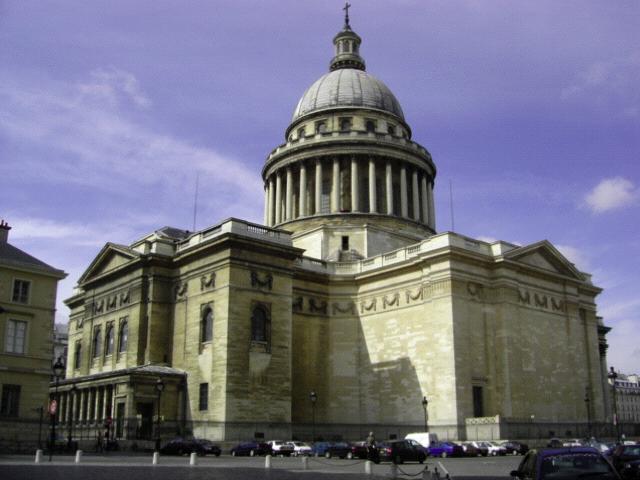
Image above is of the Panthéon in France, commemorating republican heroes.

In my last post, I discussed John Rawls on time, but with reference to ethics in David Hume and Adam Smith. One thing we get from David Hume and Adam Smith is an anti-heroic attitude to ethics. They respect the civic virtues suitable for a law governed society of property and cultivation of sensibility. In both his ethics and in his History of England, Hume refers very critically to Oliver Cromwell, the commander of the parliamentary armies in the Civil War between crown and parliament. Cromwell became ‘Lord Protector’ and the effective autocrat of England, Scotland and Ireland. Hume criticises his autocracy, but the criticism is also of the idea of a hero in general and a hero having a political role, and Hume criticises ‘heroic’ virtues like pride which he regards as asocial. Both Hume and Smith associated heroism with earlier peoples lacking in law and culture.


Rawls looks like the heir of Smith and Hume when he criticises Nietszsche in A Theory of Justice, § 50. ‘The Principle of Perfection’. He associates Nietzsche with an extreme and dangerous form of moral perfectionism. Moral perfectionism refers to the wish to follow the highest possible model of excellence in achievement. We might regard it as in contradiction with the spirit of democratic equality, though some democratic theorists now, Like Martha Nussbaum, see it as democratic, and in American history religious and ethical-philosophical (Transcendentalist) perfectionism has been linked with democratic ideas. Rawls chooses to emphasise the anti-democratic aspect and associate it with Nietzsche, who certainly does sometimes say that a society is justified by its greatest members.


Even taking perfectionism in an elitist way, as drawing attention to the example of the greatest individuals, how anti-democratic should we take that idea to be? The democracy of Ancient élites certainly emphasised heroism as an aristocratic attribute, but maybe that only refers to the aristocratic ‘democracy’ which needs to define the superiority of its members over the masses. Even so, aristocratic heroism in the stories of ancient aristocratic republican heroes like Cicero and Marcus Brutus (the leading writer against Julius Caesar and the leading assassin of Caesar), influenced 18th century democratic movements. Certainly Rousseau, a very egalitarian thinker admired antique heroes as much as believers in aristocratic constitutionalism. It was this kind of thing that Hume reacted against in his criticisms of Cromwell and elsewhere.


As we see above, France now and ever since 1791, has held remains of the official heroes of the nation in the Panthéon. This is a way of recognising an élite and the greatness of its members, exemplars for a democratic and republican people. The name itself refers to a Roman temple for the gods, so the Parisian building could be said to hold the gods of a secular republican nation. This is not something unique to French republicanism which is often contrasted with a supposedly less statist American republicanism. The United States has Mount Rushmore for four great presidents carved into a mountainside, the Lincoln Memorial for the emancipator-martyr Abraham Lincoln. Turning to Germany, on 20th July I put the case for remembering Claus von Stauffenberg as a hero. Returning to French style Republicanism, but in Turkey, Kemal Atatürk’s remains are housed in a mausoleum in the Anıtkabir complex, overlooking Ankara, Back in Britain, Oliver Cromwell is commemorated by an equestrina statue outside the Houses of Parliament, This not an anachronism as lazy commentators sometimes assume, it is recognition of the constructive role that Cromwell played in developing the British state, which did become a parliamentary within a few decades of his death. I discussed the liberal historian Macaulay on 6th July, and he certainly had that view of Cromwell though he was no advocate of Cromwell’s autocracy.


I believe that liberal and democratic thinking needs to deal with many of Nietzsche’s concerns, though we cannot say that Nietzsche is an advocate of liberal democracy, something I will return to in a later post. Whatever we might think about Nietzsche’s relation to liberal democracy, his references to a radical perfectionism are not in themselves against the spirit of democracy. Liberal democrats require exemplars, models, a personification of the ideal, they require heroes, A hero is not someone of the kind of modest virtues generally admired by Smith and Hume, but a society which is liberal and democratic, property owning and cultured, needs heroes. After all Smith and Hume are heroes for some, if people praise ‘modest’ virtues in Smith and Hume, they still praise exceptional greatness in such virtues, and heroic struggle with opposition to their ideas. Hume had himself apotheosised in the mausoleum, which I provide a picture of in my post of 12th July.

Friday, 21 December 2007

Philosophy and Gambling: Pascal and Hume

Blaise Pascal and David Hume were united by a love of gambling

Pascal's interest was as far as I understand terminated by his conversion to intense Catholicism, inspired by the Jansenism dominant at the convent at Port-Royal in Paris. Port-Royal produced distinguished philosophers like Pierre Nicole and Nicholas Arnaud and educated the great tragedian Jean Racine. Pascal's interests encompassed mathematics, physics, theology, philosophy of religion, metaphysics, epistemology, and social philosophy.

David Hume was sceptical of all revealed religion though valuing moderate religion as a part of civil society. He certainly did not engage in the asceticism that Pascal followed in his later years, and which may have hastened his death.

Though his attitude to religion was instrumental, Hume has a social philosophy similar in some respects to Pascal. For both, organised society and state institutions emerge through convenience rather than from basic principles. For Hume, this is a happy reality, for Pascal it is part of the view that God is absent from the universe, and from human society. For Hume, humans follow self-interest rooted in 'passions' (Hume used the word in a way that covers all psychological motives), and learn to adopt the rules and institutions which enable everyone's self-interest to flourish enhancing commerce and the arts. For Pascal, this is true but is evidence that humans are half angels half beast, who have lost the grandeur which belongs to divine life.

For both, a godless universe lacks certainty. The world is not guided in every respect by divine purposes, those purposes are distinctly absent. For both, there is a sceptical aspect to their philosophy, for without God's immediate presence what guarantee is there that our perceptions are reliable. Both dealt with questions of probability and chance. Science looks like it contains probabilities, though never certainties. However, some aspects of experience do not even lead us to probabilistic expectations about the future.

Gambling is an obvious example. Hume focuses in his work on knowledge, on the throwing of dice. We know there is a one in six chance of any one side being thrown However, there is nothing we can say about which is more probable, experience does not help ıs, because however many times we throw a die, for the next throw it is still a one in six chance for any one side. For Hume, that is the probabilistic nature of the universe in its most extreme aspect. For Hume, induction establishes probabilities for scientific laws of nature. However, since Hume does not think we know at what the future will be, even at the next moment, his induction has a weak basis, and even more so when we consider that induction rests on a continuity over the mind in time, which Hume thinks has not real justification, since we must regard continuous personal identity as a fiction for unifying states of mind at different times.

By his own account, philosophising brought melancholia to Hume which he relieved by gambling. The gambling, the encounter with uncontrollable chance and intrinsically futile attempts to overcome chance, or to play with chance within a framework of play between individuals which enables us to try and control chance.

Pascal saw the universe as governed by physical laws, but for him they lacked foundations. The only foundation could be God who is absent. Like Hume, Pascal contributed to early probability theory, and as with Hume we can see the gambling as resulting a fear of pure chance, the attempt to control pure chance, or the experience of surviving pure chance. Pascal also emphasised that life could be a dream, that ı could be a king dreaming that I am who I think I am. There would be no difference between being a king and the pauper who dreams vividly half the day of being a king. Our own identity is a matter of uncontrollable chance.

Pascal even produced an argument for religious faith (Pascal's wager) based on chance and simple ideas about probability. Famously, he argued that life without faith is despair. If we have faith, and there is no God, we have lost nothing and gained a life with hope; if we do not have faith but God does exist, we will have less happiness in life and we will suffer damnation in the next life. The rational thing therefore is to have faith. It is a mistake to look at the argument in isolation, as this can make it seem weak and self-deceiving, an argument in which we suppress doubt to make life more pleasant. It is just one part of Pascal's argument about belief and his arguments need to be judged as a whole. I would say that on the whole, he is building up a way of thinking in which we can only grasp reality in any way through an idea of God, which may or may not be correct in the end, but is more than a matter of comforting self-deception.

Gambling, anxiety about reality, and the wish to find a way of contolling chance, of experiencing it as part of a rational universe, or of playing with inner anxiety in order to control it are a strong feature of Pascal and Hume. Where would philosophy be without their interest in gambling?

Sunday, 2 December 2007

Gadamer, Nationalism and a Reductive view of Enlightenment and Romanticism

These thoughts come from an MA class from the Methodology course I give for the MA in Political Science in the Department of Humanities and Social Science where I am employed.

Truth and Method famously rehabilitates the concept of 'prejudice' as a term of legal process rather than as a negative term referring to a bad opinion based on poor reasoning. The use of 'prejudice' as a necessary first stage of a legal process is combined to Germany. Gadamer contrasts German usage with other usages going back to the Latin. What he does not do is consider various contextual issues in history and theory of law: Roman Law and Customary Law (which still existed in Germany in the era of Enlightenment and Romanticism), Roman Law and Common Law (English style law which gives a strong role to judicial precedent and innovation); and all consideration of law not based on a convenient German example. The section on legal hermeneutics has rather more to do with hermeneutics than law, leaving us with Gadamer's privileged example.

The German orientation is also present in his account of Enlightenment. French and 'English' Enlightenment are presented as sceptical in contrast with the historically grounded German Enlightenment. The fşrst point to make her is that the 'English' Enlightenment is better described as 'Anglo-Scottish' since the greatest figures were David Hume and Adam Smith. Other notable Scottish contributors include Adam Ferguson and Thomas Reid. Looking at the great philosopher in this context, David Hume, scepticism is a strong theme in Hume but it has an end. The end is in the habit, or custom, of the mind which provides a reliable basis for knowledge and ethics, though they cannot be based on determinate knowledge. Custom and habit also exist in history, in the accumulation of science, culture and morality. Something Gadamer could have taken into account.

The Italian Enlightenment is also pushed out of account. Vico is put in his place, by suggesting that he has failed to adopt the Hermeneutic method of moving between part and whole. Vico apparently leaves an unbridgeable confrontation between the individual and history as a whole. Another way of looking at Vico is that he shows the individual becoming more universal through history. Somehow Gadamer overlooks Vico's work on language, literature and law, which would disturb his extremely schematic contrast between Enlightenment and Romanticism. His presumed sharp separation ignores the way that Enlightenment includes the centrality of sensibility and imagination. These may have been initially conceived in mechanistic terms but that is something that is always breaking down, particularly if we consider the simultaneous development of the novel of sensibility. Gadamer claims that Romanticism is nostalgic, but the Jena Romantic Ironists in some sense invented Modernity as a value. They opposed the sentimental, romantic, modern novel to the naive, classical, antique novel in non-nostalgic terms.

Wednesday, 28 November 2007

Aristotle, Hume,Kant and Nietzsche on Ethics

Teaching Ethics
I've been teaching Aristotle and Hume (along with Plato, Kant and Kierkegaard) in an Ethics course for non-philosophers at the technical university where I work. Usually I like to teach Nietzsche when teaching Ethics, and reflecting common practice at present, the Genealogy of Morality. Usually I use the Walter Kaufmann edition, but I have also used the Maudmarie Clark and Alan J. Swensen edition. This semester I've give Nietzsche a rest, largely because as my students are not philosophy students they are more likely to pick up on the 'Nietzsche was a Nazi' myth. They are very good science students, but they lack a context to distinguish unreliable rumours in philosophy from genuine interpretation. I'm sure I'll go back to Nietzsche again in a course where I'll think of the best possible way of dispelling the infamous myth, but I'm having a break to get perspective at present.

Aristotle and Nietzsche
In teaching these philosophers I am certainly thinking about Nietzsche at all times (so it's not really cheating on Nietzsche). One thing I'm concerned about is the assimiliation of Nietzsche to Aristotelian Virtue Theory. It's a productive exercise t put Nietzsche in the context of Aristotle and Neo-Aristotelian virtue theory, but the differences are important. There is a bestowing virtue in Thus Spoke Zarathustra, but it is egotism. It is true that Aristotle's virtue is egotistical in some way. As with other Antique thinkers, he's concerned with the health of the soul, rather than assuming a burden of moral obligation. But, the Aristotelian Virtue is learned over time and becomes habitual in cognitive process with feed back as immediate knowledge of a principle becomes habitual knowledge of how to follow a principle in practice. But in Nietzsche virtue is the expression of a self which does not accept external legislation. It may be tempting to think of Nietzsche's 'Overman' in terms of the 'Magnanimous' or 'Great Souled Man' in Aristotle. However, the Great Soul man is understood through the mean between excess and lack of virtue in Aristotle. Aristotle prefers the excess of virtue over the lack, so this does lead to some Nietzschean looking thoughts on the virtues of giving and heroism. The Nietzschean Overman experiences great tensions between great conflicting forces and has to be strong enough to integrate them. The Great Souled man follows prudent habits in which we have a set of consistent virtues, which connect with no problem. Nietzsche's ethics must be understood in terms of self-invention, inner conflict and a spontaneous giving from bursting inner strength; together with a strong distinction between inner life and civic life.

Hume and Nietzsche
There are readings of Nietzsche which make him look like Hume based of the claims that both Hume and Nietzsche are: determinists with regard to the will; have a naturalistic view of philosophy and mental contents; follow a empirical-scientific model for philosophy. I doubt that Nietzsche read much Hume, his reading of the history of philosophy was patchy. He knew the Greek and Roman texts very well, and had only seriously read later philosophers in an intermittent way. This is used as argument against reading him in the context of Kant and German Idealism , but strangely not Hume. I suggest that his idea of Hume, as part of a group British psychologists, largely derives from his friend Paul Rée. The empirical-scientific model in Hume is very subjectivist-empirical undermining the objectivity of science, but that seems to be overlooke din the Humean Nietzsche readings. Nietzsche did not abandon an earlier 'aesthetic' view for a later 'scientific view', as he sees continuity between science and art. Hume's ethics of minimising pain and increasing pleasure is reactive by Nietzsche's standards; Nietzsche's ethic is one of a strength which can absorb pain and which creates without regard to a calculus of pain and pleasure; the creative uses and increases pain to increase. It seems to me Nietzsche does have a form of libertarianism with regard to the will, based on the indeterminism of nature; and one might argue Hume shuld have done the same if he had been consistent about the invented nature of causality.

Nietzsche, Kant and German Idealism
This whole topic has fallen into undeserved oblivion. It's true that Nietzsche is against the Idealist view of a strong homology between mind and nature. It's may also be true that Nietzsche's main understanding of Kant was through Schopenhauer's reading, and that he had not read much German Idealism. With Nietzsche though, it is important to realise his talent for strategic reading, on the basis of limited knowledge he was able to grasp the significance of Kant and Hegel for his own ideas, and the conflcits he was interested in. The section on duties to oneself in Kant's Metaphysics of Morals, refers to the human as the individual who commands and obeys the self. This is a very Nietzschean thought, the human strength which grows from inner conflict. The Kantian self legislates from a subjective point of view, it's good for Nietzsche, though the universality of reason is not so good for him.