Primary version of this post at Barry Stocker's Weblog, including Dali painting and not just the link!
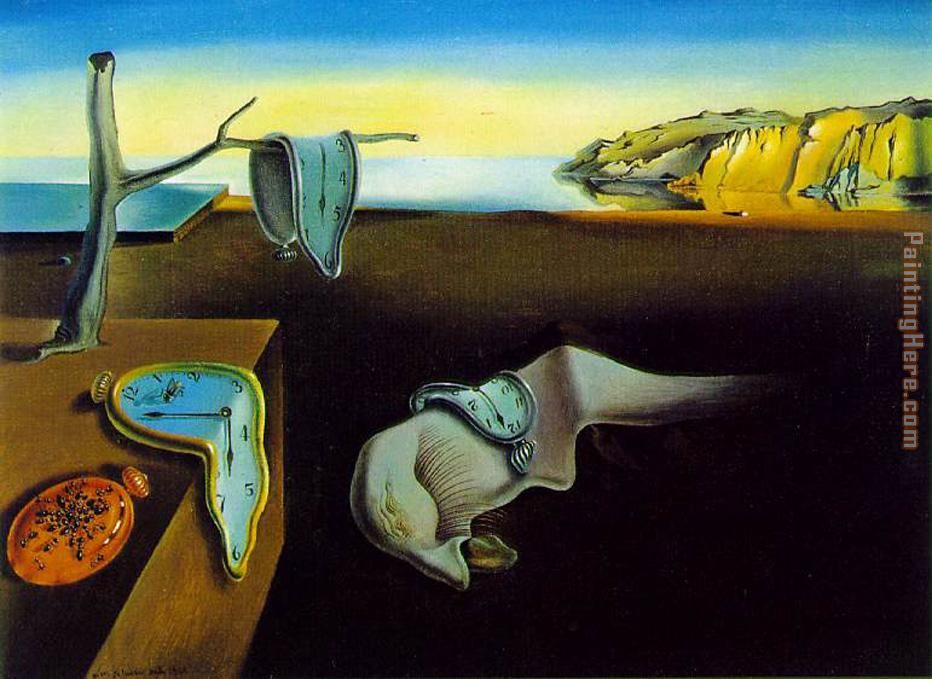
Image is Salvador Dali’s painting Melting Clocks
John Rawl’s A Theory of Justice has loomed over political theory, and related fields, since it was first published in 1971. It relies on a moment outside time to design a just society, but must incorporate time to deal with distribution over time. The interests of future selves are discounted to preserve Rawls’ notions of distributive justice, but he also relies on the interests of future selves to justify civil disobedience.
There are at least two important ways that time enters into the book.
The atemporal Original Position discussed in Chapter Three. Rawls suggests that the best way to establish a ‘thin’ (minimal in content, universal in scope) description of a society based on principles of justice way is to imagine a situation in which there are people designing such a society. To do this in the most rational way possible, they would have to exist outside normal time and space. They would design a society without knowing what position they would hold in that society and not knowing anything about its culture or its location in time or space. Pure justice is established outside time.
The temporal issues of intergenerational justice and time preference discussed in sections 44 and 45 in Chapter V. Distributive Shares. As the chapter title indicates, the problems of time in political theory emerge from the apparently non-temporal issue of distributing wealth and status in a society.
Very simply, Rawls’ position is that distribution occurs through market mechanisms (which could be in market socialist society or capitalism) under conditions of equal opportunity and a ‘maximum minimum’ for the poorest, that is the society has been designed maximise the income of its poorest members. The ‘maximin’ principle emerges early in the book. Rawls presumes that people in the original position would adopt such a principle because they may be among the poorest people in the society they are designing.
Rawls gets into questions of time through preferences over one life time between having more income now or later, which is the is issue of saving. But what Rawls really gets interested in is intergenerational justice, that is how much we invest in, and preserve existing wealth for the benefit of future generations rather than consuming in out own lifetimes. In both cases, the question of distribution has moved from distribution of income within one time slice, a slice which has no measurable duration in time, to distribution over time. This rather extreme separation is the product of looking at distribution in two extreme ways. Firstly, Rawls considers distribution as completely outside time, which does not make sense because we ought to take account of the effects of any given distribution over time. Secondly, Rawls considers distribution over time as if actions over time were just like the atemporal division of income. The problem of excluding action over time occurs again when Rawls considers temporal justice, because he has already excluded time so now he can only construct it as structured in the same way as the atemporal slice in time. Rawls does pay tribute to Aristotle’s notion of practical knowledge as concerned with actions as a whole, through the idea of rational plans. Rawls approaches this through very static notions of distribution and justice, however.
The intergenerational itself takes over from time within one lifetime. Rawls starts a discussion of saving for later stages in life, but that becomes the issue of what we should do for later generations. Rawls thinks we have to avoid equality for the later stages of life and later generations with life now and and with the present generation. He wants to avoid the idea that the present moment of life should sacrifice itself for future life and that the present generation should sacrifice itself for later generations. Sacrifice should be modest only on the basis of a discounted weight for future interests. A kind of maximin applies fro the present generation. Rawls implicitly applies the idea of a maximin to justice over time, so that we might think that in the original position the designers of justice place themselves in the present.
This apparent discounting (though not complete dismissal) of the interests of future stages of ourselves and future generations is in conjunction with a way in which the interests of future generations justify important rights now. The right to civil disobedience (non-violent law breaking and acceptance of consequent punishments in order to defend some fundamental right not recognised in law) is established with regard to the interests of future generations. They are not here to defend their interests, so we may be justified in compensating for this by using civil disobedience on behalf of their fundamental interests. At this point, we are compensating future generations for the disadvantage of not being present in our decision making which affects them.
Rawls ends up with a kind of Maximin for persons present now, but a proxy equalisation of access to decision making. These are consequences of starting with such an atemporal position. The move Rawls makes from justice across one lifetime to intergenerational justice, suggests discomfort in confronting the possibility that one self is divided between different selves with competing interests over time. Rawls has difficulty with the idea of a self which is not absolutely present to itself as unchanging entity over time. The emphasis on rational design of society is itself a way of trying to neutralise difficulties with the self: does it have free will? is it unified at one moment? is it unified over time? Is it fully conscious and and responsible in relation to all choices and all actions?