Showing posts with label Nietzsche. Show all posts

Tuesday, 2 March 2010

Nietzsche on the Neighbour; Hume on Sympathy

It seems to me that Nietzsche’s comments on the neighbour could be taken as comments on Hume’s view of sympathy in moral philosophy. I have placed a shortened version of aphorism 146 from Dawn at the bottom of this post, which I think is paticularly pertinent.

This is not a question of Hume directly influencing Nietzsche, or of Nietzsche consciously reflecting on Hume. As far as I know, Nietzsche did not read Hume and he certainly not discuss his texts. However, he was concerned with ‘English psychologists’ (On the Genealogy of Morality, Essay I, mentioned explicitly in 1 and discussed from 1 to 3) and had an idea of Hume’s ideas from their influence on German Idealist philosophy, Schopenhauer’s references, and the work of his friend Paul Rée. He refers to Rée’s book 0f 1877 in The Origin of the Moral Sensations in the Genealogy (Preface, 4).

The point is that I am arguing that there is something to be gained from thinking about some passages in Nietzsche’s as if they were polemical comments on Hume. Discussion of the ‘Neighbour’ are particularly relevant here. Nietzsche takes a critical view of the relation of ‘neighbour’ and implications he finds in it of dependence and herd existence. In particular, in this passage from Dawn, he questions the value of concerning ourselves with the suffering of the neighbour. Our automatic reaction to the pain and pleasures of others, is the most important component of moral sense for Hume (rather complicated by his scepticism and sense of social evolution), and is what he refers to as sympathy. Sympathy comes from seeing ourselves in others, and is increased by closeness in space and similarity of qualities to ourself. This is in line with what Nietzsche says about the Neighbour, who is clearly part of a general relation not just defined by living next door. This context for the ‘Neighbour’ is justified by ephorisms 143-5. 132 mentions sympathy in relation to Mill and Schopenhauer,

Nietzsche rejects sympathy for the suffering of the Neighbour in the strongest terms, welcoming the sacrifice of a few neighbours to the future, in what is is his most apparently sinister tone. However, what he also says is that we should sacrifice the Neighbour in so far as we are willing to sacrifice ourselves. This indicate that Nietzsche is probably not referring to the culling of a few people to serve the future, there is no way in which he suggests suicide in the service of the future. There are various ways in which he suggests that a willingness to take risks, and encounter danger, are valuable for the self.

What Nietzsche suggests is that we benefit the Neighbour by placing such a person under the same values of risk and danger, struggle and over-coming, as we place ourselves. In one way that is a return to ‘sympathy’, to the value a concern for commonness of concern. However, it is also a rejection of Humean sympathy, because it avoids reduction and dependency in our own sense of self. Nietzsche proposes the value of demanding sacrifice and self-overcoming, from ourselves, in the creation and promotion of a sense of individuality. Aphorism 175 takes an unfavourable line on how commerce creates a sense of the wishes of the consumer, limiting the sense of self; and Nietzsche compares the competition of commercial society unfavourably with the contests of Ancient Greece. 146 (including sentences I’ve replaced with ellipses). refers unfavourably to a morality of consequences and utility. All these remarks could be taken against Hume.


Dawn 146

Out beyond our neighbour too.— […] May we not at least treat our neighbours as we treat ourselves? And if with regard to ourselves we take no such narrow and petty bourgeois thought for the immediate consequences and the suffering they may cause, why do we have to take such thought in regard to our neighbour? Supposing we acted in the sense of self-sacrifice, what would forbid us to sacrifice our neighbour as well? […] Finally: we at the same time communicate to our neighbour the point of view from which he can feel himself to be a sacrifice, we persuade him to the task for which we employ him. Are we then without pity? But if we also want to transcend our own pity and thus achieve victory over ourselves, is this not a higher and freer viewpoint and posture than that in which one feels secure when one has discovered whether an action benefits or harms our neighbour? We, on the other hand, would through sacrifice — in which we and our neighbour are both included —strengthen and raise higher the general feeling of human power, even though we might not attain to more.

Cambridge University Press, 1997.

Original version of this post at Barry Stocker's Weblog.

Saturday, 22 August 2009

Adam Smith: Republicanism and Military Virtue

Primary version of this post, with visual content, at Barry Stocker's Weblog

Yesterday I looked at how Smith links the progress of commercial society, with all its virtues of education, culture, politeness etc., to the rise of guns used by professional armies. Reading on to An Inquiry into The Nature and Causes of the Wealth of Nations V.i.e, antique republican military virtues make a return in Adam Smith’s account of modern education. Smith thinks everyone should be educated to some degree, and this should be legally required, but with a multiplicity of providers. He’s very critical of the provision of education by schools and universities, which he argues is arranged to suit teachers not students. He prefers a more personal relationship between students and teachers, based on the availability of different instructors who have passed a public examination but are not employees of the state.

Smith’s model for this is education in Ancient Greece and Rome, particularly with regard to gymnastic and military instruction, both required for all citizens in the ancient republics, and linked with each other because as Smith has already pointed out, ancient warfare rests more on physical strength than war with guns.

At this point Smith is full of admiration for the military courage and capacities of the citizens of ancient republics. He compares this unfavourably with the spirit of modern militias (that is locally raised units of non-professional soldiers who are part-time outside a state of war). Smith has just explained approvingly how military spirit diminishes, and becomes more specialised, as societies move to commerce, prosperity and liberty.

There was an ambiguity in that I didn’t mention which is that Smith suggests the army chief and head of state should be the same, and that the army generals should be those associated with the head if states. This seems to justify early modern monarchical absolutism, which does rest on the idea that the king is the military chief in a very strong sense, and that his aristocracy provides the generals. It might just mean a return to ancient republicanism where military chiefs might be the main elected state official (e.g. Pericles in Athens), and holding a military post was a political honour.

The passage I’m currently considering pushes in the direction of ancient republicanism. Smith belongs with Montesquieu in The Spirit of the Laws (which he often invokes), Wilhelm von Humboldt (in Limits of State Action) and Benjamin Constant in an ambiguity about ancient and modern virtues and liberties. In their different ways, all these ‘Classical Liberals’ are admiring of the freedom and virtue of ancient republics, driven by the struggle for life against nature, the struggle for the city in war, absolute respect for law, and the institutions and traditions of the city. Smith, for example, is very admiring of the importance the Romans gave to the keeping of oaths (Nietzsche suggests in Genealogy of Morals that human history is about breeding an animal that can keep promises). Smith, Montesquiue, Humboldt and Constant also regard the modern world as better than the ancient world in its individual freedoms and the growth of commerce, which reduces military spirit, respect for ancient customs, and love of the state. There are many deep ambiguities in all of them on these issues.

The one way we should definitely not approach this question, is to think the Classical Liberals can be defined as people who were only concerned with ‘negative’ or ‘modern’ liberties, that is of freedom from external constraints rather than freedom which comes from participation in a community, its politics, and civic values, including courage in war and willingness to die for the common good.

Adam Smith: Republicanism and Military Virtue

Yesterday I looked at how Smith links the progress of commercial society, with all its virtues of education, culture, politeness etc., to the rise of guns used by professional armies. Reading on to An Inquiry into The Nature and Causes of the Wealth of Nations V.i.e, antique republican military virtues make a return in Adam Smith’s account of modern education. Smith thinks everyone should be educated to some degree, and this should be legally required, but with a multiplicity of providers. He’s very critical of the provision of education by schools and universities, which he argues is arranged to suit teachers not students. He prefers a more personal relationship between students and teachers, based on the availability of different instructors who have passed a public examination but are not employees of the state.

Smith’s model for this is education in Ancient Greece and Rome, particularly with regard to gymnastic and military instruction, both required for all citizens in the ancient republics, and linked with each other because as Smith has already pointed out, ancient warfare rests more on physical strength than war with guns.

At this point Smith is full of admiration for the military courage and capacities of the citizens of ancient republics. He compares this unfavourably with the spirit of modern militias (that is locally raised units of non-professional soldiers who are part-time outside a state of war). Smith has just explained approvingly how military spirit diminishes, and becomes more specialised, as societies move to commerce, prosperity and liberty.

There was an ambiguity in that I didn’t mention which is that Smith suggests the army chief and head of state should be the same, and that the army generals should be those associated with the head if states. This seems to justify early modern monarchical absolutism, which does rest on the idea that the king is the military chief in a very strong sense, and that his aristocracy provides the generals. It might just mean a return to ancient republicanism where military chiefs might be the main elected state official (e.g. Pericles in Athens), and holding a military post was a political honour.

The passage I’m currently considering pushes in the direction of ancient republicanism. Smith belongs with Montesquieu in The Spirit of the Laws (which he often invokes), Wilhelm von Humboldt (in Limits of State Action) and Benjamin Constant in an ambiguity about ancient and modern virtues and liberties. In their different ways, all these ‘Classical Liberals’ are admiring of the freedom and virtue of ancient republics, driven by the struggle for life against nature, the struggle for the city in war, absolute respect for law, and the institutions and traditions of the city. Smith, for example, is very admiring of the importance the Romans gave to the keeping of oaths (Nietzsche suggests in Genealogy of Morals that human history is about breeding an animal that can keep promises). Smith, Montesquiue, Humboldt and Constant also regard the modern world as better than the ancient world in its individual freedoms and the growth of commerce, which reduces military spirit, respect for ancient customs, and love of the state. There are many deep ambiguities in all of them on these issues.

The one way we should definitely not approach this question, is to think the Classical Liberals can be defined as people who were only concerned with ‘negative’ or ‘modern’ liberties, that is of freedom from external constraints rather than freedom which comes from participation in a community, its politics, and civic values, including courage in war and willingness to die for the common good.

Sunday, 16 August 2009

Link of the Day: Katsafanas on Drives in Nietzsche

Primary version of this post, with visual content, at Barry Stocker's Weblog.

Nietzsche’s Philosophical Psychology, by Paul Katsafanas.

Hat tip, Philosophical Papers

This is a final draft Katsafanas has posted on his personal page at the Department of Philosophy in the University of New Mexico, of an entry for the Oxford Handbook of Nietzsche (edited by John Richardson and Ken Gemes).

It’s part of Katsafanas’ general work on ethics, action and agency.


The paper’s title might be considered a bit misleading as Katasafanas very largely concentrates on the issue of drives in Nietzsche, though free will comes up as well.. The discussion of drives is very good, though ‘drive’ is not a word that Nietzsche uses very often, and not at all in some books, so it’s a bit of a stretch to take that as the dominat issue in Nietzsche’s philosophical psychology. This may reflect other aspects of Nietzsche’s philosophical psychology being included in other entries in the handbook, things like the relation between mind and body, the nature of the self, concept possession etc.


The account of drives includes a good discussion of recent positions and a clear account of Kakasanas’ preferred position. Some of his positions rests on assumptions of continuity between Nietzsche and Freud, which is in danger of distracting from Nietzsche’s texts. There’s also an assumption of continuity between Schopenhauer and Nietzsche, which is less distracting from Nietzsche’s own texts, since Schopenhauer is discussed in those texts. The claim is that ‘drive’ includes reflection, though it may refer to very automatic reactions, even at low levels of life there must be a conscious sensation in the argument. Darwin and James are also brought in to justify this position, so we end up with an account of a general approach in philosophy, biology, psychology and psychoanalysis. That opens the question of the relative merits of broad context and the details of text as the centre of focus. Anyway Katsafanas does a god job of integrating that, and other material. Katsafanas draws a sharp line between the material and the psychological, coming down on the psychological in his study of drives. I don’t see that as completely wrong, but I would argue that consciousness and psychology are emergent from material forces in Nietzsche and that these are mutually intertwined.


I very much approve of the account of free will, where Katsafanas argues that Nietzsche is a determinist, but not in a way which completely excludes agency. i might find more to disagree with on further study, but the broad sweep of argument looks correct to me.

Friday, 7 August 2009

Rawls in relation to Mill, Sophists, and Nietzsche

Primary version of this post at Barry Stocker's Weblog, with visual content!

I’ve been looking at ‘Justice as Fairness’ (1958), ‘Distributive Justice’ (1967) and ‘Distributive Justice: Some Addenda’ (1968) in Collected Papers (1999), as a result of thesis supervision work.


I noticed a Nietzsche moment at the beginning of section IV of ‘Justice as Fairness’. He refers to the ‘Sophist’ idea of justice arising from a balance of power between two hostile parties. He refers this to Glaucon at the beginning of Plato’s Republic, Book II. Glaucon was Plato’s elder brother and is explaining the Sophist view of power, after the Sophist Thrasymachus storms off in Book I. In some ways this is just setting up a position to knock it down, as Socrates quickly does. We do not have to accept Plato’s apparent dismissal, particularly as I believe Plato is more engaged with Sophist thought than his most brutal remarks would suggest,. I don’t think that’s a terribly new or controversial claim, but it’s a good thing not to forget about that aspect of Plato.


Rawls’ interest here is to take the example of justice arising from an egotistical contest. Rawls wants to pull this into the contractual situation where we agree to obey a common authority independent of our particular interests. But, this seems rather fast and I don’t think Rawls refers to this again in A Theory of Justice (1971), which is where he is heading with those earlier papers. The Sophist moment is a Nietzschean moment, in that Nietzsche somewhere refers to justice only being possible between people with equal power. I’m not going to find that quote right now, but I think I will post on it when I stumble across it. The later omission is not surprising, Glaucon’s attempt to stand in for Thrasymachus just comes too close to a way of thinking Rawls does not want to deal with: a way of thinking in which society is in a permanent state of changeable power relations between individuals, and between individuals and the state. This is a disequilibrium, always changing and does not fit in with Rawls’ rationalism. That would be rather like Foucault, as well as like Nietzsche.


The 1968 essay contains references to J.S. Mill at the ends of sections VI and VII. At the end of VI, Rawls sets up an account of Mill as egalitarian by emphasising the equality between individuals in Utilitarian ethics (ethics which derives rules from calculations of the greatest utility for the greatest number). At the end of VII, the strategy kicks in. Rawls now emphasises that in Utilitarianism, Mill refers to the greater concern individuals have for each other over history, a feeling of unity between persons, in the emergence of a society where everyone’s interests have to be consulted. Rawls now takes the jump into claiming that this is his own ‘difference principle’ (economic inequality is only justified if it maximises he income of the poorest in society compared with any other distribution of inequality).


This is too much too claim. Rawls may think Mill’s Utilitarianism leaves the way open for economic egalitarianism, and suspicions about this have certainly disturbed purist free market liberals like Hayek, and the even more purist Mises. But, Mill’s idea of utilitarianism has ideas of ranking of kinds of utility which would prevent state redistribution of income if it interferes with liberty as ‘free trade’, an important idea for Mill. Mill supports a minimum level for the poorest, but not a reduction of inequality except as a secondary effect of the minimum level. Rawls thinks of inequality as something that has to be justified, Mill thinks of interruption to ‘free trade’ (including free markets in general) as a something that has to be justified and usually there is no adequate justification.


These ideas of individuals becoming more interested in each other are nothing to do with egalitarianism. Mill was an enthusiast for Humboldt’ Limits of State Actions (1792), which has a more extreme position that that of Mill with regard to a minimal state. Humboldt thinks of such a minimal state allowing more free interaction between individuals and growing sympathy, than can be achieved by the machine like associations between people resulting from state intervention. Something similar can be found a bit earlier in Adam Smith and David Hume, who thought human society is moving towards greater unity through increasing moral sympathy, together with the work of free trade. Neither thought that would lead to, or should lead to, state directed redistribution of income beyond what is entailed by relief for the poorest. Rawls brings Kant behind the ‘difference principle’ as well as Mill and some similar reservation apply. He is also trying to do something similar with Hume and Smith.


Rawls account of the ‘difference principle’ is itself quite ambiguous, sometimes the need to let the market economy works seems to be a very strong constraint, sometimes equality for its own sake seems to be the really strong constraint imposing a pattern of income distribution in a designed way, difficult to reconcile with the constant change, feedback and unpredictability of the market.


The instability of power relations and income distribution are both troubling for Rawls. His tendency to try and repress them, he economic side in particular, may explain his tendencies to try to deny the recognition of the unpredictability of interactions between individuals, including economic relations.

Sunday, 2 August 2009

John Stuart Mill and Nietzsche on Individualism

Primary version of this post at Barry Stocker's Weblog, with picture of Mill, not just the link.

John Stuart Mill picture in the image above.

I always find it creates a bit of a shock if I suggest that John Stuart Mill and Nietzsche had much in common about anything. It’s true that Nietzsche was rather rude about Mill and that they expressed contradictory views about parliamentary democracy and the women’s movement. However, it is also true that it would be absurd to interpret Nietzsche according to the first impression his provocative rhetoric gives; and it would be absurd to say that two philosophers who disagree could not have underlying agreement in the area where they have some disagreement.


Nietzsche’s criticisms of 19th Century liberalism need two major qualifiers:

He expressed admiration for liberal figures like Voltaire, Mirabeau (a leading moderate in the early stages of the French Revolution) and Kaiser Friedrich (very briefly German Emperor between William I and II, and unlike them a supporter of liberals in German politics).

His criticisms of parliamentary democracy, and democratic culture, are expressions of the same criticisms that 19th Century liberals had of the culture and politics of the time.


The general context for this, is that 18th and 19th Century liberalism was very anxious about the consequences of a democracy which incorporated voters with little, or no education and property. As much as anything, liberals of that time were concerned with restricting the possibilities of levelling down egalitarianism and incoherent populist surges in democratic politics threatening individual righys, and in the earlier part of that period tended to prefer limitations on voting rights. I would say that idea broke down with Tocqueville’s Democracy in America (1835-40), a major influence on Mill, which really established the idea that it was only a matter of time before all developed countries became fully democratic. Mill himself thought political rights should be denied to ‘barbarous’ peoples, like Tocqueville he thought such peoples should be educated for civilisation and democracy through colonialism. Even in the advanced countries, Mill was concerned with uneducated voters participating in the political process and suggested giving more votes to the more educated. Sometimes, Mill comes very close to suggesting a new aristocracy of education, and intellect, should be ruling in ways that insulated them from waves of popular feeling, amongst the uneducated. In some sense, the existence of a constitution and laws, interpreted by judges not popular assemblies, makes that true of all modern democracies; something Tocqueville who was from an old aristocratic family noted with great interest.


That’s the background, let’s list some specific points where Mill and Nietzsche agree

Modern society promotes conformity and uniformity which undermines the existence of strong and diverse individuals.

Traditions and customs, particularly religion, are chains on the mind which should be cast off.

Traditions and customs, including religion, produced the great, strong, and varied individuals of the past.

We need to find ways of producing great, strong, and varied individuals for the future.

A society is at least partly justified by its creation of particularly notable strong and varied individuals.

Higher cultural values should be recognised, and defended against uniformity in culture, which always descends to a low level.

State decisions should never be based on the immediate desires of an uneducated mass.


I believe that clearly establishes some common ground. Further commentary on this would looks further at themes common to Mill, Tocqueville and Nietzsche; and would consider the relation to Mill and Nietzsche to the kind of liberalism established by Wilhelm von Humboldt in The Limits of State Action. Mill refers directly to this text. and while I’m not aware of any direct references in Nietzsche the parallels are most striking. These issues should be coming up in future posts.

Link of the Day: Guay on Genealogy in Nietzsche

Primary version of this post at Barry Stocker's Weblog, with picture not just link to picture.

Image is pictures of Nietzsche

I found ‘Genealogy as Immanent Critique: Working from the Inside’ by Robert Guay at PhilPapers Unpublished Papers Section. It will be published in The Edinburgh Critical History of Philosophy, Vol. IV, edited by Alison Stone.


Nietzsche is the focus of the article, but it looks at the idea of genealogy in a comprehensive way with reference to Rousseau, Kant, Hegel, Mill, Marx, Adorno and Foucault as well. Guay suggests that the idea of genealogy (evolution of concepts) is not distinctive in Nietzsche, but his critical use is, Nietzsche does regard historical development as justification, so his genealogical explanations of moral terms, and other concepts is highly critical.

Wednesday, 29 July 2009

Nietzsche on Art in The Gay Science, Books I and II

Primary version of this post at Barry Stocker's Weblog, with picture not just link.

Image shows original printing of Nietzsche’s second edition of Gay Science

The Gay Science, in its title expresses Nietzsche’s wish for some kind of fusion of art with science (or knowledge, Wissenschaft could be translated as either though science is the most normal). The idea of science is clearly there, and the idea of something aesthetic is hinted at with gay (fröhliche) The idea of the aesthetic is made more clear with the subtitle, la gaya scienza, a Provençal (Occitan i.e. southern dialect of French particularly associated with medieval Troubadour poetry and music) phrase for the poetry of the Troubadours. Unlike Human, All Too Human, in Ecce Homo, Nietzsche defined The Gay Science as a ‘yes saying’ book, along with Dawn and Thus Spoke Zarathustra. So these are the books where Nietzsche claims to have put forward a positive philosophy rather than a rejection of other philosophies. This reinforces the sense of a work which is poetic and aesthetic in its conception, and this is finally confirmed by Nietzsche’s addition of poems, narrowly speaking, to the second edition of The Gay Science.

I’m thinking here about section I in Book I, and about most of Book II. It says something about the centrality of art in The Gay Science that it starts with art, in a double way, poetry followed by discussion of art. Nevertheless, there are those who are inclined to see The Gay Science, and all Nietzsche’s work from Human, All Too Human as rejecting art as having a central role in Nietzsche’s philosophy, on the argument that Nietzsche’s naturalism (his rejection of any force or thing outside the natural world) entails a positivistic privileging of science in his philosophy. I think this is just wrong, but I’d rather not contribute to a spirit of bad temper between commentators. It’s not a bad thing to emphasise the role of science, and the study of humans as part of nature, in Nietzsche and it’s certainly no more wrong than only seeing Nietzsche as engaged in an aesthetic philosophical self-reflection, that is only concerned with the possible styles of philosophy. I’m not sure that any major commentator has actually seen Nietzsche that way, and I am sure that it is a mistake to think that Derrida read Nietzsche in that way. Perhaps some people working on ‘post-structuralist’, or ‘post-modern’; or rhetoric or metaphorical or literary approaches to Nietzsche have come too close to that point of view, and I seem to remember getting too close to that in the earliest stages of my postgraduate studies. If people want to work on Nietzsche in a ‘philosophy as style’ mode or they want to work on Nietzsche as an early cognitive psychologist, I don’t see a problem, and the same goes for people who see Nietzsche as a historian, a sociologist or anything else I might have forgotten. I would just prefer everyone concerned to approach this is an inclusive way, but there’ll always be some who find it necessary to attack all approaches other than their own.

We’ve seen in the post of July 27th why some commentators might think Nietzsche is against aestheticism in Human, All Too Human, but as I argued in the post of July 26th, there is already a movement back and forth between knowledge of nature and aesthetics in Birth of Tragedy, and a complicated set of statements about whether art has some value from the point of view of knowledge or is the production of illusion. After my recent (re)reading of The Gay Science I’m very inclined to the view that Nietzsche at all points is trying to articulate the view that art contains knowledge because it refers to experience, that art is the expression of natural forces in the human body, and that art creates illusions but illusions which make us see life in a better way rather than creating a complete deceit.

What Nietzsche suggests in The Gay Science is that poetry begins with the attempt to impress the gods through rhythm and that tragedy makes life bearable (which seems continuous with Birth of Tragedy). That seems to lend itself to the line that Nietzsche rejects art as illusion. I would say that Nietzsche has certainly rejected the view that art could refer to an underlying metaphysical reality, but I would also say that he never completely accepted such a view. There is maybe more of a clear rejection now. I certainly do not see that at is rejected as something that gives us knowledge. Art still is what draws our attention to appearances and then maybe to appearances as the only reality, or that there is no model of reality-in-itself behind appearances and art is part of what helps us get that point, which needs to be experienced not just argued. Nietzsche clearly signals that his book is a way of getting us to experience philosophy as something that comes through the fine and sensitive use of language (unlike what I can manage), including its symbolic possibilities. That does not exclude the existence of knowledge claims within it.

Section 107 at the end of Book II, is I think particularly useful. It’s easy to remember beginning and ending sections which maybe why I’m referring to them, but I think that Nietzshe worked particularly hard in this case on making the first and last sections of books memorable, long and complex, as an appropriate way of giving form to his argument. As Section 107 is long and complex, I won’t quote or even paraphrase it. I’ll just say that it puts forward the view that art creates illusion, but not dishonest or destructive illusions. The illusions of art distract us from the more painful aspects of living, but they also draw our attention to these aspects in giving them enjoyable form. These illusions also allow us to to stand above our claims to knowledge and morality. They allow epistemic and ethical scepticism, by showing situations above customary knowledge and morality in a kind of superior existence. The poetic exaltation of an existence in which we do not follow moral rules or prevalent assumptions about knowledge, does not just narcotise us against suffering, though it does have that role. The narcosis is a relative narcosis and it also provokes the courage to question and reject. In this way art provides beautiful illusions and penetrates illusions. There are different kinds of illusion and they can be used against each other. In the early sections of The Gay Science, Nietzsche also argues that what is useful to life is mostly against morality, though also sometimes might be in line with morality as the Utilitarians believed (they believed that good means what promotes the greatest utility, benefit, for the greatest number). Art is part of this amiguity, in which the artist may help or hinder ‘life’, and could do both with regard to higher and lower forms of life. Art can be a stimulus to a more affirmative abundant life, and if not it is an effective way of exploring a collapsing negative form of life, and it can be difficult to say which. The artists may lie to themselves but still produce a stimulus to life. All views of life, all claims to knowledge are illusory, in the sense that none of them present unchallengeable knowledge. The illusions of art, even the self deception of the artist still provides perspectives which something of reality. All appearances are part of reality and there is no higher reality and art may make us particularly aware of that.

Monday, 27 July 2009

Art in Nietzsche, Human, All Too Human, §§ 221-3

Primary version of this post at Barry Stocker's Weblog, with picture, not just link to picture!

Image is of front cover of the original edition of Human, All Too Human

Art Reborn or the Death of Art?

Paragraphs 221 to 223 come at the end of Human, All Too Human, ‘From the Souls of Artists and Writers’ The paragraphs have the three following headings: ‘The revolution in poetry’, ‘What is left of art’, ‘Evening Twilight of Art’.


Classicist Rebirth of Art

This looks to me like a moment where Nietzsche counter poses views that cannot be easily reconciled. § 221 refers to a decline and rebirth of art. The decline comes from the loss of Hellenic and French classicism. Nietzsche refers to the modern French as those closest to the Ancient Greeks. He seems to be particularly referring to the Seventeenth Century tragedies of Pierre Corneille and Jean Racine, which follow very closely classical practices in which the action of a tragedy takes place within very tight limits of time and space, and overall unity. What he refers to most explicitly here though is Voltaire who wrote various tragedies, which do not now attract much interest. Nietzsche refers to the decline of the status of French classicism as Shakespeare’s tragedies became more elevated in status throughout Europe, despite their lack of conformity to classicist rules. Nietzsche refers to this as ‘naturalism’, as the return to the original nature of art. He looks at the reactions in Germany where the dramatist and art theorist Gotthold Lessing criticised classicism in comparison to Shakespeare, and Friedrich Schiller who follows classicist rules in his tragedies despite criticising classicism in his aesthetic theory. The English poet and adventurer Byron appears as the most thorough advocate of anti-classicism in thought and practice in which form is overwhelmed by chaos.


Nietzsche refers to Goethe as someone who follows anti-classicism in his famous verse-drama Faust but then repents of the results of naturalism: formlessness and copying. He returns to the Hellenic-French classicism of a simplicity which becomes myth, forms above pathological problems, masks, universal allegory. Goethe here gets the kind of status Nietzsche had awarded to Richard Wagner in Birth of Tragedy, the unique figure who brings back the force and unity of ancient art. The German nationalism entwined with his earlier praise of Wagner is overturned by making the French classicists Goethe’s predecessors in preserving classicism.


Death of Art

The last two paragraphs of Human, All Too Human 4 investigate another thesis, the death of art, or at least its death as the supreme form of knowledge. Nietzsche suggests that art was closely tied to the inquiry into truth, with accurate depiction of experience and attempts to portray some deep metaphysical reality, as in religious art. The most powerful aspect of art is that it shows humanity as part of nature. Science has now taken up that role. Earlier German thinkers had already suggest some link between the activity of art as an aspect of mind and nature and the activity of science which shares those aspects. Nietzsche takes a step beyond that, in suggesting that these common aspects of art and science are part of the inevitable move from the primacy of art to the primacy of science. There is some precedent for this in Hegel who had argued that art was giving way to philosophy as a way of dealing with the highest kinds of truth and reality. For Hegel, the greatest art, certainly in the sense of having a structure related to the overall nature of reality, belongs to the past, including the epic works of Homer, Virgil and Dante which could be said to present a comprehensive and unified view of an intelligible world. The novel seemed less important to Hegel, though some Hegel commentators insist that he is referring to shift from determinate to free form rather than a decline, I believe this is an evasion of the issue. Free form for Hegel means still beautiful but lacking in the cognitive and moral significance of earlier art. For Hegel, philosophy in its metaphysical/logical and phenomenological structures takes over from art. Nietzsche makes science the heir of art in a commitment to enquiry, and does not give it the kind of metaphysical and phenomenological structure Hegel does, preferring a more empiricist and sceptical approach.


Resolution?

I’m no offering a final view here, just reporting on work in progress. My guess though is that there is no final resolution. Nietzsche gives us two views to consider. We might prefer one to the other, we might try to find a way of unifying them, or we might see this as an inevitable problem of reason trying to reach a final universal point of view with no contradiction (somewhat in the manner of antique scepticism in Sextus Empiricus and modern empiricism in David Hume, which is to some degree informed by the ‘Pyrrhonic’ approach of Sextus. Right now, I would say that last option is Nietzsche’s general approach and the explanation behind the tension at the end of Human, All Too Human 4. This is, however, a provisional conclusion.

Sunday, 26 July 2009

2 Points about Nietzsche’s Birth of Tragedy, section 3.

Primary version of this blog is at Barry Stocker's Weblog, with picture not just link to picture!


Picture shows ampitheatre of Athens, where the Ancient tragedies were staged.


Reading section 3 of Nietzsche’s Birth of Tragedy today, I have two comments to make on contentious issues in Nietzsche.


Nietzsche’s view of tragedy is not that of a lie to escape life.

Nietzsche’s view of Homer challenges the classification of Ancient Greek literature as naive.


On the first point: (quotations are from Walter Kaufmann’s translation)


“The same impulse which calls art into being, as the complement and consummation of existence, seducing one to a continuation of life, was also the cause of the Olympian world which the Hellenic “will” made use of as a transfiguring mirror”


Actually I can see why someone might want to say this is about creating a lie (as Julian Young does in Nietzsche’s Philosophy of Art), but nevertheless I think the best interpretation is that life contains the possibility of creating this triumphant joy, as well as containing the suffering Nietzsche also refers to here as essential to human life The essential nature of suffering does not make artistic joy a lie, since the possibility of that joy is essential to life as well. The joy of Ancient Greek art includes the happy life of the gods, as Nietzsche says, but Nietzsche also refers to the way that Ancient Greek mythology shows the Olympian gods as only pre-eminent after a war with the Titan gods (see Hesiod’s Theogony). So suffering is not absent from the lives of the Greek gods who represent the justification of life. Tragedy itself is not a lie of beautiful happy life, it dwells on the suffering of life, but creates joyful beauty from it.


This is not a lie in the sense of deceiving someone about reality, but the suggestion of a way of looking at the world. Nietzsche does sometimes in various texts refer to the illusions and lies of art, but I think this is best thought of in relation to Nietzsche’s view that we have to look at many truths or perspectives, not just one. The idea of perspectivism in Nietzsche has become controversial as the more naturalist-scientific commentators are absolutely desperate to avoid any hint of relativism in Nietzsche. Let us leave aside relativism, or ontological questions about the relations between perceptions and ‘real’ objects, and just remember that referring to a number of perspectives is not the same as a relativistic claim that perspectives are incompatible. Nietzsche does sometimes refer to contradiction, but this is not the same as saying perspectives contradict, anyone perspectivism does not require a radical belief in pure relativism.


On the second point:


“The Homeric ‘naiveté’ can be understood only as the complete victory of Apollinian illusion: this is one of those illusions which nature so frequently employs to achieve her own end.”


Again, it’s not surprising that someone might take this as a statement that art is a lie to distract us from existence, but the context in the previous paragraph is of the Olympians overthrowing the Titans, a story well know to Ancient Greeks familiar with Homer and tragedy. There is a dream in Homer, and an Apollinian suppression of the tragic, but this is in epics which contain constant violence, death, cruelty, fear and suffering. Nietzsche emphasises that the supposed “naiveté” of Homer is itself an illusion.


The context for the “naive’ in art is Friedrich Schiller’s 1794 distinction between naive and sentimental in art, which was taken up by Friedrich Schlegel and other ‘Romantic Ironists’ a few years later. In this view, Ancient art is not reflective or concerned with inner conflict, but modern art is which is why it ‘sentimental’ in the sense of a play of feelings and actions of the mind. Something like this distinction carries on into the early Twentieth Century in Georg Lukács’ Theory of the Novel. Though Lukács was very familiar with Nietzsche he does not think of Birth of Tragedy as challenging Schiller’s aesthetic stages. Nietzsche casts doubt on this view in arguing that at the beginning of known Greek literature, the Apollinian beauty of surfaces which is equated with the naive, is itself an illusion created by the artist in a work which also contains a Dionysian awareness of death and suffering. The Dionysian itself is not a belief in the futility of life, since it promotes festivals of joy in nature.


If Nietzsche is referring to a lie in art, it is more in the way that the Dionysian is associated with Schopenhauer’s metaphysic of will, than in the beauty of the Apollinian. In some ways, in his account of the Dionysian, Nietzsche seems to take Schopenhauer’s metaphysics as given, but the emphasis on the enjoyment if nature does not really seem like Schopenhauer, for whom that sense of nature could only be the means to a union with universal will. In Schopenhauer, nature leads us immediately to pure ‘Ideas’ and despite what the distinguished commentator on Nietzsche’s aesthetics, Julian Young says in Nietzsche’s Philosophy of Art, I can’t see these Platonist ideas in Birth of Tragedy.

Saturday, 25 July 2009

Nietzsche: Physiology and Tragedy

Primary version of this post at Barry Stocker's Weblog, with image not just link to image

Image is of the front cover of the first edition of Birth of Tragedy

Birth of Tragedy, (Walter Kaufmann translation) Section 1, paragraph 2

In order to grasp these two tendencies [Dionysian and Apollinian], let us first conceive of them as the separate art worlds of dreams and intoxication. These physiological phenomena present a contrast analogous to that existing between the Apollinian and the Dionysian. It was in dreams says Lucretius, that the glorious divine figures first appeared to the souls of men; in dreams the great shaper beheld the splendid bodies of splendid bodies of superhuman beings...


Section 15, paragraph 5 (paragraph 3 in German)

Therefore Lessing, the most honest theoretical man, dared to announce that he cared more for the search after truth than for truth itself—and thus revealed the fundamental secret of science to, to the astonishment, and indeed the anger of the scientific community.


It seems to me that the two quotations above from Birth of Tragedy (1872) have not been discussed enough in Nietzsche commentary. I might have missed something in the vast volume of Nietzsche commentary in various languages, but they certainly have not been emphasised much by the better known commentators of international reputation.


The first quotation introduces the physiological into the idea of the Dionysian and Apollinian as necessary contrasting elements of art. Nietzsche’s phrasing seems to waver between regarding the physiological phenomena of dreams and intoxication as the basis of the Apollinian and the Dionysian, and as analogies for them. In any case, we are invited to see art as the outcome of the struggle between, and unity of, two physiological drives. Surely this distances Nietzshce from a completely non-natural Romantic metaphysics of art. A Romantic conception could seek a basis in nature, but in any case that would reduce the opposition between a Romantic-Metaphysical conception and a Naturalistic-Scientific conception. Maybe it is not a good idea to think of Birth of Tragedy as a left over from ‘Romanticism’, an idea itself which excludes reflection on what Romanticism is.


The second quotation introduces a notion of the relation between science and art which is picked up again in Human, All Too Human (1878). The notion that art and science are connected in the search for truth and that both would die without a continuing search. Sometimes in Human, All Too Human, Nietzsche seems to be saying that art has given way to science in the great search, and this sometimes taken as indicating a break with Birth of Tragedy. But as we see, the idea is already being explored in the earlier book, which already deals with an approach to science I addressed in a post of 5th July ‘Nietzsche Prophet of Karl Popper: Art and Science’.


I’m strongly inclined to doubt that Birth of Tragedy represents a non-naturalistic approach deeply at odds with Nietzsche’s later texts. In some current work on Nietzsche I am concerned with oscillation between aestheticism and scientism (including their combination), and it seems to me that such an oscillation is evident in Birth of Tragedy.

Link of the Day: Nietzsche Source.

http://www.nietzschesource.org/

Hosted by the École normale supérieure in Paris.

Hat tip: Continental Philosophy


This is now on my Favourite Sites section


Looks like an essential tool for everyone working on Nietzsche. Giorgio Colli and Mazzino Montinari German language editon of the Collected Works online and searchable, and facsimiles of original manuscripts. The last aspect may not be working very well at present though, I opened specimen pages with Safari and Firefox browsers, but could not see any text.

Friday, 24 July 2009

Nietzsche, Philosophy, Art

Primary version of this post at Barry Stocker's Weblog, with Munch painting, not just the link.


Image is Edvard Munch’s painting Nietzsche (1906)

Some general points about approaching Nietzsche in relation to art, as I’m starting some work in that area. What aspects of this could there be:

The aesthetic theory in Nietzsche’s philosophy

Nietzsche’s philosophical writings as literary art

Artistic reactions to Nietzsche’s texts


What problems arise under these headings?

How do we construct a theory of art from Nietzsche’s various books unifying different comments which are expressed in ironic, provocative, playful, hyperbolic terms?

How do we see Nietzsche’s texts as both philosophical arguments and works of literature?

There is much artistic material relating to Nietzsche: Richard Strauss, Gustav Mahler, Thomas Mann, Knut Hansun, W.B. Years, Rainer Maria Rilke and so on and so on. How can we possibly unify these different reactions across different art forms?


There cannot be a final answer, but I would like to suggest a few guidelines some of which seem obvious but nevertheless have sometimes been ignored.

Nietzsche has a constant interest in the relation of art, philosophy, nature and knowledge.

The literary-rhetorical-stylistic aspect of Nietzsche’s arguments should never ever be overlooked.

The complexity and literariness of Nietszche’s philosophy should never be used as a pretext to ignore philosophical theory on Nietzsche.

Abstracting from particular texts and passages of texts is very dangerous, and it’s not a very good idea at all to ever assume that Nietzsche’s philosophical development reaches a mature ‘final’ stage with a complete theory.

There is no complete break between an earlier metaphysical-Romantic Wagner-Schopenhauer follower and a later empirical-Naturalist Boscovich-Hume follower (Roger Boscovich is an 18th Century Polish physicist mentioned with great enthusiasm by Nietzsche).

Nietzsche is at no time ‘essentially’ an aesthetic-Romantic, or naturalistic-Positivist, or psychological-Cognitivist, or social-historical figure. Elements of all of these can be found across his work.


Some of the debate about the relation between art and knowledge in Nietzsche at different stages of his work, could I believe be assisted by more attention to the Idealist and Romantic background. This may have been well covered in some German commentary, but not in a way which has affected English language commentary. Looking at the German Idealists from Kant and the brief flowering of Ironic-Romantic philosophy in Germany in the last few years of the 18th Century; art, science and nature come together. This is surely very obvious, it can be seen in Kant’s Critique of the Power of Judgement, the first part of which refers to the beautiful and the sublime and the second part of which refers to nature. Nevertheless, if much work has been done on relating this to Nietzsche it seems to have slipped my attention on the many occasions I’ve looked at Kant and Nietzsche commentary. Nietzsche may not have been a great reader of the relevant texts, but that’s not the only way of measuring influence, and there are certainly direct and indirect indications in Nietzsche’s texts of awareness of this material.

Hume, Smith, Rawls, Nietzsche and Heroic Virtues

Primary version of this post is at Barry Stocker's Weblog, with picture, not just link to picture!

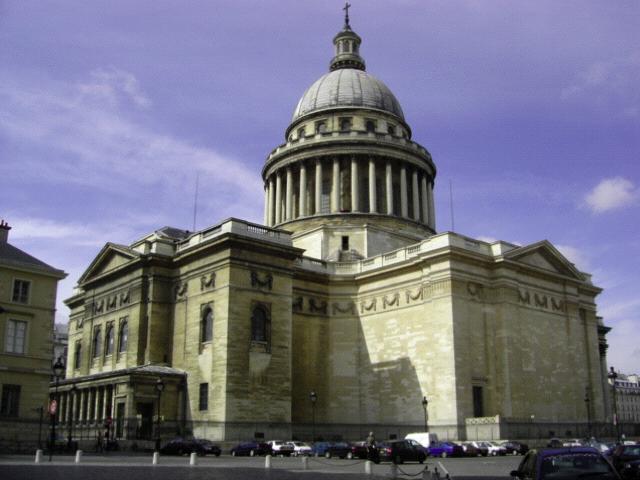
Image above is of the Panthéon in France, commemorating republican heroes.

In my last post, I discussed John Rawls on time, but with reference to ethics in David Hume and Adam Smith. One thing we get from David Hume and Adam Smith is an anti-heroic attitude to ethics. They respect the civic virtues suitable for a law governed society of property and cultivation of sensibility. In both his ethics and in his History of England, Hume refers very critically to Oliver Cromwell, the commander of the parliamentary armies in the Civil War between crown and parliament. Cromwell became ‘Lord Protector’ and the effective autocrat of England, Scotland and Ireland. Hume criticises his autocracy, but the criticism is also of the idea of a hero in general and a hero having a political role, and Hume criticises ‘heroic’ virtues like pride which he regards as asocial. Both Hume and Smith associated heroism with earlier peoples lacking in law and culture.


Rawls looks like the heir of Smith and Hume when he criticises Nietszsche in A Theory of Justice, § 50. ‘The Principle of Perfection’. He associates Nietzsche with an extreme and dangerous form of moral perfectionism. Moral perfectionism refers to the wish to follow the highest possible model of excellence in achievement. We might regard it as in contradiction with the spirit of democratic equality, though some democratic theorists now, Like Martha Nussbaum, see it as democratic, and in American history religious and ethical-philosophical (Transcendentalist) perfectionism has been linked with democratic ideas. Rawls chooses to emphasise the anti-democratic aspect and associate it with Nietzsche, who certainly does sometimes say that a society is justified by its greatest members.


Even taking perfectionism in an elitist way, as drawing attention to the example of the greatest individuals, how anti-democratic should we take that idea to be? The democracy of Ancient élites certainly emphasised heroism as an aristocratic attribute, but maybe that only refers to the aristocratic ‘democracy’ which needs to define the superiority of its members over the masses. Even so, aristocratic heroism in the stories of ancient aristocratic republican heroes like Cicero and Marcus Brutus (the leading writer against Julius Caesar and the leading assassin of Caesar), influenced 18th century democratic movements. Certainly Rousseau, a very egalitarian thinker admired antique heroes as much as believers in aristocratic constitutionalism. It was this kind of thing that Hume reacted against in his criticisms of Cromwell and elsewhere.


As we see above, France now and ever since 1791, has held remains of the official heroes of the nation in the Panthéon. This is a way of recognising an élite and the greatness of its members, exemplars for a democratic and republican people. The name itself refers to a Roman temple for the gods, so the Parisian building could be said to hold the gods of a secular republican nation. This is not something unique to French republicanism which is often contrasted with a supposedly less statist American republicanism. The United States has Mount Rushmore for four great presidents carved into a mountainside, the Lincoln Memorial for the emancipator-martyr Abraham Lincoln. Turning to Germany, on 20th July I put the case for remembering Claus von Stauffenberg as a hero. Returning to French style Republicanism, but in Turkey, Kemal Atatürk’s remains are housed in a mausoleum in the Anıtkabir complex, overlooking Ankara, Back in Britain, Oliver Cromwell is commemorated by an equestrina statue outside the Houses of Parliament, This not an anachronism as lazy commentators sometimes assume, it is recognition of the constructive role that Cromwell played in developing the British state, which did become a parliamentary within a few decades of his death. I discussed the liberal historian Macaulay on 6th July, and he certainly had that view of Cromwell though he was no advocate of Cromwell’s autocracy.


I believe that liberal and democratic thinking needs to deal with many of Nietzsche’s concerns, though we cannot say that Nietzsche is an advocate of liberal democracy, something I will return to in a later post. Whatever we might think about Nietzsche’s relation to liberal democracy, his references to a radical perfectionism are not in themselves against the spirit of democracy. Liberal democrats require exemplars, models, a personification of the ideal, they require heroes, A hero is not someone of the kind of modest virtues generally admired by Smith and Hume, but a society which is liberal and democratic, property owning and cultured, needs heroes. After all Smith and Hume are heroes for some, if people praise ‘modest’ virtues in Smith and Hume, they still praise exceptional greatness in such virtues, and heroic struggle with opposition to their ideas. Hume had himself apotheosised in the mausoleum, which I provide a picture of in my post of 12th July.

Saturday, 15 March 2008

Nietzsche and Burckhardt

I've finished reading Burckhardt's The Greeks and Greek Civilization. It's a great work on politics, culture, religion and many things in Ancient Greece. It really tells a story about the road to Golden Age Athens, and a decline in Athens, followed by the destruction of the Ancient Greek world as it was taken over by the Macedonian monarchy and absorbed into the Hellenistic world resulting from Alexander's conquests. Today I'll highlight a few things which seem particularly relevant to reading Nietzsche, who was Burkhardt's friend and colleague at the University of Basle.

Burckhardt strong emphasises the role of competition in the Ancient Greek world. The Greek states were united in the Olympic games, and there were many other forms of competition. The great Athenian tragedies were written for competitions. There were all kinds of contests in gymnastics, poetry, and music throughout the Greek world. Communities took enormous pride in the achievements of locals in the Olympic games and other contests. The pride in winning and the efforts made to win were extreme. This can be seen in the wounds suffered by wrestling and the great interest of tyrants in backing winning teams. This should remind us of two early essays by Nietzsche on 'The Greek State' and 'Homer on Competition'. It also provides a perspective for understanding 'master morality' in Nietzsche.

Burckhardt regards the interest in competition as part of the Aristocratic culture. It also existed in democratic Athens, and was the source of its great achievements. The attitude of the great democratic leader Pericles to Athens power in Greece itself shows this. However, the democratic world undermined competition. Excellence and the competition for excellence became the kind of jealousy and urge to denunciation, which led to the trial and death of Socrates. Athens after the Peloponnesian War weakened under the influence of this kind of spirit in which demogogary, perjury, and parasitic law cases became dominant. Here we see why Plato preferred Crete and Sparta. However, Sparata itself lost its old civic virtues at this, according to Burckhardt, becasue its very somination of Greece made it weaken under the influence of the other parts of Greece.

For Burckhardt, democracy means an individualism based on the cult of excellence and the growth of resentment. The decline of the aristocracy which vreated the values used by democracy allows great culture to flourish, but only for a limited period. These aspects of Burckhardt are close to Nietzzsche's thoughts on politics and culture throughout his life, and should be taken into account.


Thursday, 31 January 2008

Nietzsche's Friend Jacob Burckhardt: How a Conservative 19th Century Historian Anticipated 'Poliitcally Correct' views of Antiquity.

I've just started reading The Greeks and Greek Civilization by Jakob Burckhardt. Burckhardt was a friend and colleague of Friedrich Nietzsche at the University of Basle. Unlike Nietzsche, Burkhardt was a native of Basle. He turned down the chance to succeed to Leopold Von Ranke's chair in Berlin. Ranke was a great historian, who preached objectivity and the importance of archives, but also wrote history from the point of view of the Prussian dynasty. Burckhardt rejected Ranke's Prussian-German nationalism, but from a conservative point of view. In this he followed the precedent of Goethe. The emphasis Burckhardt puts on the individual above national state ideology also gives him a liberal aspect, like Nietzsche. They were both suspicious of democracy and mass culture, from the point of view of an individualism which stands above conservative tradition, particularly in its religious aspects. At the very least Nietzsche and Burckhardt turn conservative tradition into an instrument of individualism, and Nietzsche certainly found it possible to take the same view of democracy. Both of the Basle Professors shared an early enthusiasms for the philosophy of Schopenhauer. Both were attacked by the brilliant but narrow minded philologist Ulrich von Wilamowitz-Mollendorf.

I was previously familiar with Burckhardt's The Civilization of the Renaissance in Italy, which looks at the individualism of the Renaissance as a movement in politics and statecraft as a well as art, and which clearly bears comparison with Nietzsche. In fact both books by Burckhardt are essential companions to Nietzsche's philosophy (that is not to say they are the same in all respects).

The focus of today's post is the way in which Burckhardt anticipates attitudes to antiquity from a 'politically correct' point of view since Martin Bernal's Black Athena. I do not have a firm view right now of Black Athena, or any text influenced by it. I may return to this in the future, all I have to say for now is that I am sure that Bernal addressed issues that need to be addressed about the place of Greek antiquity in the broader antique world. It may or may not distort history for political reasons. It may or may not mix such distortions with valid points.

The issues that are associated with Bernal and his followers that matter regardless of the value of what they wrote: the Greek polis (city state) follows the example of earlier states in the Near East; there are ways in which aspects of Ancient Greek thought that take things from the Near East: some aspects of Near Eastern culture and thought were in advance of Greek culture and thought in antiquity.

Where does Burckhardt come in?
1. The Greek polis, to some degree, was preceded by Phoenician city states in which the supreme power of rulers was limited by an aristocratic council.
2. Ancient Greek culture took many things from the Ancient Assyrians and Egyptians.
3. Ancient Greek culture seemed immature to the Ancient Egyptians due to its faith in immediacy and lack of any real transcendence of perception.
4. Ancient Greek culture had an instrumental attitude to truth and oath taking whoch shocked other Antique peoples and this is not just a case of seeing the worst in another culture.

Burckhardt emphasised other things that undermine the idealisation of Ancient Greece, particularly the view of the polis as the goal of human existence. Burckhardt emphasises that the polis emerges from extreme violence on villagers. A polis was formed by forcing inhabitants in a group of villages to leave their homes and live within fortified walls. The reasons for this were militaristic. The process in which villagers were forced to live in a polis in constant military conflict with rivals is what lies behind Greek myths of sacrifice (voluntary and involuntary) to the interests of the state and the harsh punishment of critics of the state. Villagers had the cruel experience for Ancient Greeks of being torn from the graves of their ancestors. Legal codes were designed for the aristocracy who struggled to protect original laws against amendment and addition by the people. 'Democracy' was based on one group forcing itself on other peoples and subordinating them to itself. This could happen because citizenship excluded slaves and those of foreign origin, as well as women. Greek gods were immoral and this limited Ancient Greek moral understanding, which included obsessions with revenge, though this was mitigated to some degree by philosophy. However, even philosophical ethics was primarily concerned with the health of the individual self, not obligations to others.

Tuesday, 22 January 2008

Philosophy and Literature: Thomas Hardy's Mayor of Casterbridge

A recent rereading of Thomas Hardy's novel The Mayor of Casterbridge has inspired a view thoughts about philosophy and literature.

It is a novel which is particularly close to tragedy, as define dby Aristotle in The Poetics, a hero falls in the world and endures suffering as the result of an error of judgement. As a novel, The Mayor of Casterbridge repeats the situation in a structure more complex than tragedy. An Aristotelian terms. a repeated tragedy within an epic. The tight structure of tragedy is repeated across a work with the episodic associational structure of epic.

The tragic falls: Henchard sells his wife while drunk and angry with her; Henchard ruins himself later when he is a wealthy farmer and a mayor, by engaging in a reckless attempt to win a commercial battle with his ex-friend and manager Donald Farfrae; he misses the chance to marry his ex-girlfriend before Farfrae wins her over; he misses the chance to tell his step-daughter Elizabeth-Jane that he is not her biological father when he finds out himself: he misses the chance to tell the truth to Elizabeth-Jane and her biological father. He goes through many little falls due to his self-destructive character leading to our next topic.

The hero Michael Henchard has many 'anti-hero' qualities. He is a loner and is disposed to arbitrary destructive and self-destructive acts. He is a Dostoevskian character in this sense, and has some resemblance with the heroes of Knut Hansun, themselves presumably drawing on Dostoevsky. Like Dostoevskey's characters he tends to promote scandal. One memorable example is his attempt to welcome a member of the Royal Family to Dorchester after he has fallen from being mayor and is a rather disreputable laboourer.

The anti-hero, I believe, receives its classical description and theorisation in Lukacs' Theory of the Novel. Lukacs refers to the growing contradiction in the novel between the hero and the world. The hero does not see herself in the world and cannot follow the laws of the world. There is an opposition between subjectivity and the world. The hero can increasingly only exist as insane or criminal. In this argument, the anti-hero is the necessary hero of the novel since Cervantes.

The Dostoevskian aspects of Henchard, irritability, irrationality, self-destruction, provocation of scandal, excessive pride coexisting with excessive humility, draw us towards Bakhtin"s discussion of the novel through Dostoevsky in Problems of Dostoevsky's Poetics. Bakhtin emphasises all these aspects of Dostoevsky in a discussion of what he takes to be the ideal form of the novel in Dostoevsky. The most Bakhtinian concern is the provocation of scandal and that leads us to the preoccupations of Rabelais and his World. Famously Bakhtin there dwells on the carnivalesque as an important moment in popular culture until recent times, referring to festival moments where social hierarchy is inverted, and power is mocked. The rise of Henchard from labourer to mayor and rich farmer, and his subsequent fall to labourer again has this structure in general. One moment in the novel particularly suggest the Carnivalesque. This is the 'skimmity ride' in which disreputable local characters humiliate a couple in the novel. In general the Skimmity Ride is a rural practice of mocking a couple where the wife does not 'belong' wholly to the husband. In this case they the locals parade large dummies of Henchard and his ex-girlfriend Lucetta. The intention is to humiliate Lucetta and her husband Donald Farfrae. The consequence is that Lucetta miscarries and dies. This is the Carnivalesque as a festival of resentment, rather then the neo-Marxist reading of Bakhtin in which the Carnival is the release of popular radical energies. In this case, the mocking of power is clearly an example of evil, and is described in terms of every kind of economic, social and psychological resentment coming to the surface. It very much suggests Rousseau on self-love and imagination, and Nietzsche on ressentiment.

In its tragic aspects, Hardy's novel seems to confirm Hegel and Kierkegaard's analysis of the difference between Ancient and Modern Tragedy. Ancient Tragedy refers to the burden of fate carried by a family or a nation , it refers to pollution that afflicts the hero which comes from an unconscious or inherited transgression of boundaries. In Modern Tragedy, the hero bears all this alone from deliberate willed decision. Henchard demonstrates a strong sense of unbearable guilt not just at his actions, but at his who,e existence. The novel ends with his desire to be forgotten. Elizabeth-Jane is left to reflect in a more measured novellistic way on the burdens of existence, so tragic elements are modified by the novellistic which presents a whole world or varied fortunes. The tragic elements also have to be seen in terms of Schopenhauer, whose philosophy Hardy knew,a s did many literary writers of the time. Henchard's sense of the futility of existence is like Schopenhauer. The role of tragedy relates to Schopenhauer, as does the role of music. Henchard is partly destroyed because he normally lacks the music which communicates with his inner self, a view of music clearly taken from Schopenhauer in The World as Will and Representation.

Thursday, 17 January 2008

Envy in Rawls: Rousseau, Nietzsche and Resentment

Rawls versus Nietzsche
Chapter 81 of Rawls' A Theory of Justice addresses 'Envy and Inequality', with passing reference to Nietzsche. Nietzsche appears on three occasions in the book, and is the representative of what is bad. H eis lined with Aristotle as Perfectionist, a follower of the morality of self-perfection. Nietzsche is presented as giving an egomaniac version of perfectionism. Aristotle's moral ideal is an emotionally controlled slave owning aristocrat who regards himself as superior to slaves, labourers, foreigners and women. That does rather leave a question mark over any assumption that Aristotle is morally preferable to Nietzsche, but our main concern here is the comments on envy. Nietzsche turns up as the bad philosopher who finds envy everywhere. Rawls quite rightly observes that Nietzsche places envy at the centre of social relations and psychology.

Ressentiment, Envy and Egalitarian Liberalism

Structure of Ressentiment in Nietzsche
Rawls does not think that envy is an intrinsic part of human relations. For Nietzsche, envy as ressentiment, is at the heart of all psychology and social relations. Consciousness itself is constituted in the pain of the denial of instinct, and that denial is repeated in the origins of society. Those structures of ressentiment are given another form in the relation of master and slave, which reduces the slave to ressentiment in the powerlessness which prevents the execcution of revenge against the master. Ressentiment clearly translates from French as 'resentment' and as it contains the word 'sentiment' brings in strong overtones of feeling itself. Nietzsche regarded the animal which can feel consciously as the animal which has a consciousness structured by ressentiment. In Nietzsche, that refers to the desire for revenge frustrated and turned into an impotent obsession with imaginary punishment. It is suggested that time itself produces such a reaction, as time places the past outside the power of consciousness. The realisation of the relation is a major dramatic and structural element of Thus Spoke Zarathustra; and is discussed in On the Genealogy of Morality in a relatively discursive manner.
Eliminating Envy in Rawls
Rawls refers to envy as the product of inequality that cannot be justified to those who have less. The idea of justified inequality is a pillar of Rawls' thought. It is expressed in his famous 'difference principle'. That principle is presented as the product of a rationality that precedes actual social relations, that is the 'veil of ignorance' which allows the design of a political system without regard to the place of the designer in any hierarchy in that system. Difference, that is inequality, is justified where it benefits the worst off in that society, where it increases the living standards of the poorest. The point of the chapter is that following the difference principle eliminates envy. Where the poorest can find that inequality raises their living standards, the inequality does not result in envy. That envy avoidance requires special measures to compensate for unjustified inequality, e.g. disadvantage that results from disability. Rawls' liberalism here seems rather utopian, envy will be eliminated by sufficient public spending judiciously targeted.
Philosophy of Envy in Rousseau and Nietzsche
Rousseau is one of the main positive references for Rawls. Strangely he omits the account of envy in Rousseau's discourse on inequality. Rousseau thinks of envy as emerging after the institution of property where individuals compares themselves with each other, and imagine how they appear in the imagination of others. This is the negative opposite of the sympathy Rousseau thinks humans feel for each other by nature. The possession by any person of more than other people will result in this envy. Rousseau sees envy as the inevitable result of inequity, All that can avoid envy is complete equality between individuals.

A Silence in Rawls
Rousseau exists in Rawls in a rationalised form, as a theorist of contract. The more extreme and disturbing aspects of Rousseau are silently excluded in Rawls. Instead we get a framework for rationally limiting envy. There is a lot of scope for intervening against unjustified inequality through compensation, but no scope for eliminating inequality. Rousseau accepted that large states will have social inequality, but is guided by the ideal of an autarchic community of small property owners. No such state can exist for Rawls. The Rtawlsian society is not driven by the energies of envy, or passion of any kind.

Conclusion
Rawls imagines a system of political justice which excludes passion. Envy itself is based on a depersonalised comparison between individuals. Rousseau's citizens are driven by political and social passions, Rawls' social actors are driven by a rational conception of society detached from individual interests and passions. Both Nietzsche and Rousseau deal with the human animal separated from nature, Rawls imagines a purely rational agent abstracted from any individual desires.