Thursday, 25 June 2009

Istanbul Political Philosophy Conference: Day 1

Primary version of this post at Barry Stocker's Weblog. Include picture of the beautiful campus used for the conference!


PHILOSOPHICAL PERSPECTIVES ON PEACE III

South Campus of Boğaziçi (Bosphorus) University (Pictured above)

Today I’ve been attending the first day of a philosophy conference in Istanbul, largely taking Kant’s essay on ‘Perpetual Peace’, an essay on 1795 on the possibility of a peaceful world federation of republics. What Kant meant by a republic is essentially what we now call liberal democracy, representative, democracy, or constitutional democracy. The conference was hosted by the Boğaziçi Philosophy Department, and was largely organised by Lucas Thorpe who is teaching there over the Summer. I have know Lucas for some years in the Turkish philosophy scene. He has organised many international Kant events, and is himself a very good scholar of Kant, moral theory, and early modern philosophy.


The first speaker was Howard Williams of the University of Wales, Aberystwyth, editor of the Kantian Review and well known for his work on Kant’s political thought. His paper title was ‘Natural Right in Perpetual Peace’. Williams discussed the move in Kant from early modern theories of natural right to his own metaphysics of morals. Natural right, refers to those ideas of what is just that are so universal amongst humans that they can be said to be ideas of what is just by nature. Kant moves from ideas of what is right by nature, and is naturally know to be right by nature, to an abstract set of moral principles created by human intellect and clarified by philosophical inquiry. Williams looked at two problems in the theory of natural law: 1 the place of individual freedom. 2. the place of state sovereignty. Wiiliams identified Hobbes as someone whose solution was to subordinate individual freedom. This is based on Hobbes’ theory of authorisation, according to which if I accepted the law and order offered by a sovereign body, I have become the author of all its actions because I have consented to this sovereign. Hobbes made this a theory of the individual state only. He though that the ‘law of nations’ (law governing nations) is the same as the violent chaos of relations between humans in the time before sovereign governments are established. In Kant the state becomes like a moral person bound by law. Williams thinks there is a tension here here between the law that exists now guiding nations towards law governed peace in Kand the existence of peace in the future. Morality and natural providence (the way we behave by nature) combine to lead us to become aware of the moral and practical advantages of peace. In the discussion after the talk, Williams offered the following further explanations: the state is a moral person in relation to other states, not in relation to individuals in the state as this would destroy their status as free moral persons; unlike Locke (and more recently Nozick), Kant does not see rights as belonging to individuals ontologically (by virtue of existing as individuals) but through the moral development of civil society over history.


Lucas Thorpe was the next speaker, with the title ‘Perpetual Peace and Impossible Ideals’. He concentrated on the ideals of peace and the moral will needed to come closer to peace. Thorpe suggested that in Kant, perpetual peace may be impossible, but we should still will to achieve the necessary moral will in order to at least raise ourselves above our existing moral level.


Jacob Beck of Texas Tech University spoke on ‘The Roots of War: The Evolutionary and Cognitive Origins of Human Warmongering’. He discussed human tendencies to war from the point of view of anthropological and psychological evidence, including comparison with chimpanzees. Humans and chimpanzees are unique amongst all animal species in ‘lethal raiding’. That is males from one group murder males from other groups, and rape and kidnap females from other groups. This kind of activity in hunter gathered leads to a death rate amongst young males of 30%, much higher than in modern societies despite continuing wars. There is a genetic reason for such behaviour, as makes who do not die have more descendants. That genetic motive may be shared between humans and chimpanzees. However, Beck also discussed the possibility that ‘lethal raiding’ might be the accidental outcome of intelligence; and also discussed the difficulty of distinguishing generic determination from psychological adaptation.


Next, Bill Wringe of Bilkent University, Ankara (someone else I have known for several years in the Turkish philosophy scene) spoke on ‘Armed Humanitarian Intervention and the Duty to Promote Peace’. He discussed differences between the state of nature between individuals in Hobbes and his theory of international relations, there cannot be a complete correspondence though it might sometimes look as if Hobbes thinks there is. Wringe thinks it’s difficult to defend armed humanitarian intervention in other states (to prevent mass killing in particular), because Kant demands the renunciation of any future use of force. In the discussion, it was suggested that Kant might allow for intervention where state authority collapses because of civil war.


Keziban Der of UIC (University of Illinois at Chicago) finished the day with ‘Peace and Global Poverty’. This was an exposition and defence of Thomas Pogge’s view that poverty in low income countries is the result of an unjust world economic order, in which for example natural resources are extracted without full compensation for the local population. This is understood through ‘double effect’, the ways in which action with good intentions may have bad consequences. Der argued for bad consequences to be taken more fully into account and for the global poor to receive income transfers from the rich of the world. The discussion moved into the issue of whether inequality is necessarily the result of injustice. It was suggested from the audience that economic life must be competitive and it is not unfair for there to be a winner in any competition for an economic reward, and that national law income comes from poor governance. I presume that could be developed into the claim that competition generates wealth for everyone though in any individual competition there have to be losers as well as winners. The total effect of a series of competitions over time is to improves everyone’s welfare. It was also pointed out from the floor that Pogge is adotping an idea from Rawls, ‘the difference principle’ in which inequality within a nation is only justified if it benefits the poorest. Pogge tries to turn that it into a global principle, justifying global income transfers. It was also suggested that this would be very difficult to achieve and that in practice Pogge was arguing for a more limited income transfer than full application of the difference principle would suggest.

Wednesday, 24 June 2009

Hobbes: Difference between Law, Contract, Custom

Primary version of this post (with picture of Hobbes!) at Barry Stocker's Weblog.


‘They confound law and covenant who conceive the laws to be nothing else but certain [...] forms of living determined by the customs of men’

Thomas Hobbes

De Cive (Of the Citizen)

XIV, 2


Thoughts here are rather provisional reflections while reading De Cive, but are very much what I have to think over time are the problems in Hobbes’ political theory.


Hobbes here refers to Aristotle, quoting in Greek and an English translation. He does not give references to the Aristotle quotation, and I cannot find the source except that I have found similar passages in Politics VI 1. The broad point is that what is legal or sovereign in Aristotle is what citizens are use to agreeing on.


Hobbes point is that his antique and republican predecessors have confused contract with law and also custom with law. When Hobbes refers to antique and republican predecessors he is referring to Plato, Aristotle, Cicero and Seneca. All see government coming from consent of the citizens through law and custom. The idea of Plato as a Republican thinker of government based on consent is somewhat against current stereotypes about Plato, but those stereotypes need reassessing.


The most direct point Hobbes makes here is that law is more than covenant. Covenant is the term Hobbes used for the contract which establishes a sovereign body to represent and rule a people. It seems to me that there is some trouble for Hobbes in wanting to make covenant the basis of sovereignty and then make covenant less than the sovereignty of law. Leaving that aside, Hobbes’ point is that we must distinguish between particular contracts as agreements between citizens and the agreement to which maybe no living individuals have explicitly consented, that is the agreement to obey the laws passed by the sovereign body.


In this way, Hobbes makes a clear distinction between anarchy, which he refers ti as the state of nature, and civil society. When i say anarchy, I do not mean in the negative sense of chaos, I mean in the positive sense of a social order based on purely voluntary co-operation.


Both senses appear in Hobbes. When he talks about a state of nature, he refers to constant war. As far as I am aware, there is considerable evidence that the earliest human societies of small bands were frequently at war with each other and lost a higher proportion of the population to war than modern industrial societies, even allowing for the 20th Century European wars. However, Hobbes also seems to allow for a city which has yet to establish a covenant for instituting sovereignty. In this case, he must believe in a civil society of a kind before sovereignty. There may be a problem for Hobbes here.


Hobbes makes a strong case against anarchism, or a purely contractual voluntary, view of relations between humans. He also refers more obliquely to the belief that laws are based on custom, which looks like criticism of some kinds of conservative thought. In the context of his time though, it is maybe more another way of criticising antique republicans and their early modern followers. For the ancient thinkers Hobbes criticises , the best laws and constitutions are those which spring from the customs of a city and are not imposed by the law making body. I think Hobbes detects anarchist undertones, the idea that laws can exist and be applied without a sovereign body to make and enforce them. What Hobbes criticised does not disappear in the early modern period. A century later, Montesqueiu and Rosseau conceive of a republic in its ideal form as an almost stateless state, in which laws are customs. These aspects of Montesquieu and Rousseau were of great interest to radical republicans like Robespierre and Saint-Just in the French Revolution. In power, they took this to mean they should enforce the kind of virtue which can be found in the customs of ancient republics.


When thinking of Hobbes, we should not just think of the idea of the unlimited sovereign power, but also of a distinction between law and custom or contract, which leaves custom and contract distinct from political questions of sovereignty, and therefore free of state intervention and domination.

Tuesday, 23 June 2009

Michael Sandel Reith Lectures Genetics and Morality

(Primacy version of this post, with picture of Sandel! is at Barry Stocker's Weblog)

Sadly I have to say, an argument for restricting individual freedom, and a worrying tendency to confuse eloquence in explaining why Sandel does not like something at the level of subjective preference with circumstances which would justify legal restrictions.


I’ve just listened to Michael Sandel’s third Reith lecture with this link which is only available for another week. Hopefully the BBC will archive this link and those for Sandel’s other Reith lectures.


Sandel begins by explaining his role in a committee advising George W. Bush on stem cell research. Sandel was in a minority in the committee which favoured allowing federal funds for such research. Objections to stem cell research refer to the need to create and then destroy a human embryo, while carrying out medical research into possible therapies using such cells. The follow up to Sandel’s permissive position on stem cell research is his restrictive position on genetic enhancement.


Sandel’s position is that genetic manipulation is permissible for medical curative purposes, but not for enhancement. Forms of manipulation he thinks should be banned include parents choosing genetic modification with regard to: sex of a child, height of child, beauty of child, sporting abilities of child, intellectual capacities of child.


It only becomes clear at the end of the talk in the question and answer section that Sandel favours banning these things. That might be considered implicit in the main body of his talks where he is very eloquent on why he does not like these things. However, there is a big difference between an eloquent explanation of why you do not like something and giving reasons for making it a criminal offence. It worries me that Sandel did not follow that distinction, and unfortunately could probably rely on his audience to perceive that he was arguing for bans, not merely explaining a preference. It worries me that so many people many not see a big jump between saying you don’t like something so that you would prefer it not to happen and saying that the coercive power of the state should be used to stop something ever happening,


Sandel’s general argument for opposing ‘non-medical’ genetic modification is that it undermines our humility in relation to nature. It undermines the sense of the ‘unbidden’ that parents have towards their children as something they cannot control. In general it leads to a Promethean sense of hubris. When Sandel refers to the Promethean, he is referring to Ancient Greek myth of Prometheus who stole fire from the gods so that humans could have it. ‘Hubris’ has a modern meaning of pride and excess, but I’m sure Sandel was thinking of its origins in Ancient Geek morality, and the belief that humans should stay within bounds. I’ve always regarded Prometheus as admirable and I believe many people always have. Why does Sandel think the human restlessness and desire to improve the human condition, symbolised by Prometheus, is such a bad thing? Big changes in human society, going back to the primeval use of fire are good things, unless you believe that we should live like pre-literate pre-historical, pre agricultural humans in bands of hunter gatherers. The first use of fire, the invention of agriculture, the construction of towns, the invention of writing are all crossings of boundaries as are all the cultural, political and technological developments since we value.


Of course Sandel is not arguing for some kind of obscurantist primitivist return to the the earliest kinds of human life, but then why use terms which taken seriously might lead in such a direction. If that’s what Sandel has got to throw against genetic modification then he has not got much at all.


I suppose Sandel is distrurbed by the way technology can ‘interfere’ with our ‘natural’ genetic make up, but the whole history of human development is that of changing nature in ourselves and in our environment. That can have harmful aspects, as in pollution of the environment, but that in itself is not an argument against using genetic engineering to get more of things we think are valuable: beauty, athletic ability and intelligence.


On the specific issue of choosing the sex of babies, Sandel could have a point, presuming that parents are too inclined to prefer one gender over another. The consequences of a big imbalance between men and women in the population are very negative, certainly for heterosexuals in the bigger gender group, and I think it’s reasonable to restrict this possibility through the law. However, Sandel clearly goes beyond this. He just finds it intrinsically repulsive, i.e. Promethean and hubristic, to choose the sex of children. That’s a good reason why he might choose not to participate in the practice and might argue for that preference with others, but how is it a basis for coercing others unless there is a demonstrable negative consequence. That is a negative consequence beyond Sandel own feeling of reverence for creation and nature, which strikes me as a remarkably poor basis for coercing others.


Sandel thinks that potential parents are showing less love for their future children if they choose genetic modifications which make them more beautiful, athletic, or intelligent. I find it peculiar to say there is a lack of love where parents seek an advantage for their future children. Sandel thinks this shows a lack of love for any children they might have who are not beautiful, or athletic or intelligent. This simply does not follow. If parents make every effort to get a good school for their children, but their children are in the end very weak in academic achievements would that mean that the parents would have to love them less? Certainly not.


An eloquent talk by Sandel but overall a frightening tendency to believe that the state should coerce other people to follow certain standards of his own about not being Promethean. What’s wrong with being Promethean? Many people have considered Prometheus a hero. I certainly do.

Monday, 22 June 2009

Hoppe: Habermas’ Anarcho-Conservative Student

(Primary version of this post, with picture of Hoppe! at Barry Stocker's Weblog)

Hoppe and Habermas

Hans Hermann-Hoppe is Jürgen Habermas’ most surprising doctoral student, a major figure in the area where anarcho-capitalism and ultra-conservatism cross over. (Click for a very short article by Hoppe which summarises his positon in a discussion of immigration) Hoppe wrote a doctorate with the Frankfurt School Marxist, Habermas in the 1970s. Hoppe is not very forthcoming about this, as can be seen by checking his CV at his own website, but does situate himself in relation to Habermas in his book The Ethics and Economics of Private Property. The startling conjunction of Marxism and Anarcho-Conservatism is a bit lessened if we appreciate Habermas’ position as a bridge between left-liberalism and Marxism, so that he can be better regarded as someone who has domesticated Marx within welfarist or egalitarian liberalism, rather than as an advocate of revolutionary Marxism.


Hoppe’s Version of Discourse Ethics

Hoppe takes up the discourse ethics of Habermas (and Karl-Otto Apel) which is itself an attempt to fuse a neo-Kantian ethics of pure universal law with an account of language use and communication as what attempts universal meaning. Habermas takes discourse ethics up in a ‘deliberative democracy’ in which all social and economic questions are debated in a public sphere so that agreement can be reached upon a political solution, within the limits of the existing legal and constitutional structure. Hoppe’s take on this is that discourse ethics must rest on the individual’s self-property in the individual’s body. The right to dispose of that naturally given property is taken as something that we cannot try to deny in discourse, without getting into self-contradiction since the source of discourse is the self which necessarily has property in its body as an aspect of being an individual self. This is itself a development of John Locke’s view of property, though how far Hoppe’s interpretation accords with Locke’s own philosophy as a whole is a matter of debate (and I think it is not).


Hoppe , Rothbard and Austrian Liberalism

Hoppe’s main influence came later, when he worked with the best known anarcho-capitalist thinker, the American historian, economist, political theorist and activist, Murray Rothbard. Rothbard himself tooted his views in Austrian Liberalism (also known as Austo-Libertarianism and and Austrian Economics). The best known representative of ‘Austrian Liberalism’ is F.A. Hayek, though is also the most moderate representative. Rothbard was a follower of Hayek’s teacher, Ludwig von Mises, who was much more minimum state and conservative in his thinking than Hayek, though Hayek moved some of the way in that direction later in his life. It’s significant that Hayek dropped the aristocratic ‘von’ from his name, unlike Mises who decided to ignore Austria’s abolition of aristocratic titles after the Republic was refounded after World War Two. Like Hoppe, Rothbard was strongly associated with the Mises Insitute. The institute would perhaps be more accurately known as the Rothbard Institute, since it leans towards anarcho-capitalism rather than Mises’ own minimum state position. Though it gives great attention to Mises, it leans towards Rothbard where Rothbard had a different position (naturalistic ethics rather than subjective ethics, anarchism rather than a minimum state). Hayek and Milton Friedman were fellows of the Institute, but it’s important to appreciate that they are not really libertarians by Mises/Rothbard standards. Hayek and Friedman never denied the need for some public services and some aid for the poorest, a position rejected by core Mises Institute thinkers. The Institute, and Hoppe, can be better understood by noting the connection with the Paleo-Conservative/Neo-Confederate, Paul Gottfried who is more radical minimum statist than Hayek or Friedman, and who strongly prefers the Confederate military commander Robert E. Lee as an American icon to Abraham Lincoln (who defeated the secession of the slave owning Confederate States of America from the Union in the Civil War).


Hoppe against Democracy

Hoppe generally describes himself as libertarian or anarcho-capitalist, but I cannot see that he would reject the ultra-conservative label, or I certainly do not see how can do so consistently, since he prefers monarchy to democracy. That is he prefers rule by one hereditary individual to rule by a representative assembly, or by direct democracy, and clearly regards the global move from monarchy to democracy as regrettable. His explanation is that a hereditary ruler has a great interest in maintaining the state since it belongs to that ruler and the descendants of that ruler in perpetuity. The hereditary ruler’s interest in maintaining the state is certainly greater than that of elected politicians, as these politicians are temporary and have a greater interest in extracting resources from the state than in maintaining it’s long term existence. That’s not a position I share, but it is very interesting to note the existence of the argument and think about it before arriving at a view of it. The conservative side of Hoppe can also be


Bodrum: Centre of Anarcho-Conservatism

Hoppe has founded his own association, Property and Freedom which meets every year in Bodrum. Turkey is not the most obvious place for a centre of anarcho-capitalism, but Hoppe had a wealthy Turkish supporter Gülçin İmre, and Bodrum’s a great place for a holiday. I’m sure the beaches and bars provide much needed relaxation from struggling against democratic decadence.


Hoppe Misusing Hayek?

The website evades these more radical aspects of Hoppe’s thought though, relying heavily on quotations from Hayek who never even used the word ‘libertarian’ as he found its too radical. As time went by Hayek, did become more anxious to distinguish himself from left-liberals, so he replaced the self-description of liberal with the quaint term ‘Old Whig’, also wishing to avoid the term conservative. This refers to the earliest supporters of the British Parliament against royal power in the Seventeenth Century. The association uses the phrase ‘culturally conservative libertarians’, next to a quote from Mises commenting on Hayek. This contradicts by association, that is it associates Hayek with two terms he rejected: libertarianism and conservatism, but avoids outright contradiction by directly quoting Mises.


Back to Habermas: Locke behind Marxism and Libertarianism

How could Hoppe move from Habermas’ moderate Marxism to a radical anarcho-conservatism? There is not much literature on this, or discussion by Habermas or Hoppe, but G. A. Cohen has some interesting things to say about Marxism and capitalist libertarianism (mostly with reference to Robert Nozick in Self-Ownership, Freedom, and Equality. Cohen himself has moved from Marxism to a very radical form of liberal egalitarianism. One reason Cohen has for this transition is that Marxism is not innately egalitarian, or certainly not in a consistent way. It emphasises the idea that property comes from labour, using the Lockean idea also used by many anarcho-capitalists and free market libertarians. Cohen suggests that Marxism is about the labourer having absolute property rights over the products of that labour, excluding income transfers with an egalitarian purpose.


Habermas and Capitalist Libertarianism: Pure Transparent Community

I would add that Habermas’ gaol of an ‘ideal speech situation’ in his theories of discourse ethics and deliberative democracy is itself utopian, the dream of speech detached from any distortions of self-interest and subjectivity. That utopia might be better realised in the self-governing micro-communities of property owner imagined by Hoppe, rather than in a nation state as Habermas imagines. Habermas takes this even beyond the nation state to the European Union and a then a global cosmopolitan public sphere.

Sunday, 21 June 2009

Weber and Political Liberalism: Passion and Force

(This post is available in its primary form, with images, at Barry Stocker's Weblog)

Following from last Friday’s post on ‘Weber’s Theory of Charisma in Politics’, I’m addressing Weber’s contribution to liberalism. I believe this is a contribution that needs to be appreciated more in points which disturb some self-described liberals, but should certainly be taken up any liberalism that is worth while. A liberalism that incorporates the realities of force and passion in human character and in political communities.


Politics is based on the pursuit of power, not the implementation of norms.

Legal norms only have meaning where a power exists that can enforce them.

The existence of effective powers requires individuals with effective rights to give orders at the top the power structure.

The legitimacy of a system of political representation rests on the ability of individuals with power to inspire others with the belief that they are suited to wield such power.

Political communities are nations, so the existence of a political community requires nationalism.

The international order requires states which are capable of exerting power beyond their borders.

Politics is competition for power and therefore rests on individual competitiveness, which is the desire of individuals to be greater than others.

Competitiveness is the basis of economic growth and of political growth.


These positions are often taken to be in contradiction with liberalism, either in the positive sense that liberalism is above such impurity, or in the negative sense that liberalism is too devoted to abstract norms to be able to deal with these issues.


I argue, following Weber, and some others, that liberalism as a complete theory, acknowledges and incorporates these elements as necessary to the existence of a law governed community of individual rights and representative government.


The ‘others’ will be discussed in later posts, here I will just mention Machiavelli, Tocqueville, and Foucault (mostly with regard to later texts).


Accepting these points does not mean that we embrace unlimited dictatorial power for individuals, though it does require that specific individuals always exercise power.


It does not mean there is no distinction between legal order and state force, though it does recognise that a state force greater than any sub-state force is necessary for there to be legal order.


It does not mean that there must be a cult of personality of national leaders, though it does mean that we recognise that a successful political community creates political actors who command unusual levels of respect.


It does not mean supporting nationalism of an aggressive kind, or national identity based on religious, ethnic, or cultural exclusivity and purity. It does require that recognition of national pride (along with other forms of pride in identity) is part of the existence of a political community.


It does not exclude the existence of international law or trans-national institutions, though it does require that certain nations take particular responsibility for giving force to the declarations of such bodies.


It does not require opposition to the existence of the European Union, or the greater integration of the European Union. It does require recognition that national pride (and sub-national regional pride) are inescapable and often positive motives for action, and that European integration rests on a growing sense of European pride.


Where to find Weber’s political ideas


Weber: Political Writings

Cambridge University Press, 1994


Saturday, 20 June 2009

Vico and Foucault: Aesthetics and Sovereignty

(Primary version of this Post including images in post, not just linked, at Barry Stocker's Weblog)

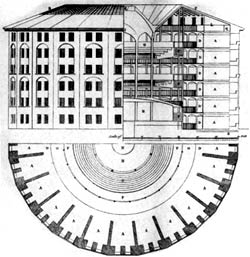
The image above shows Giambattista Vico’s frontispiece for his New Science Concerning the Common Nature of the Nations (1725, 1744). Vico uses the image, and the relations between the objects in it, to explain the method of his ‘new science’. This anticipates the uses of images Michel Foucualt makes in some of his books. For example, at the beginning of The Order of Things (1966) he uses Velázquez’ painting Las Meninas and in Discipline and Punish (1975) he makes a central reference to Jeremy Bentham’s model prison, the Panopticon, using Bentham’s blueprint as an illustration (see below). In these cases, the images are not mere ‘decoration’, the spatial relations within them are important to grasping the points made about law and sovereignty.

Both Vico and Foucault were concerned with the way in which the social world is revealed by aesthetic experience. Vico’s concern with the poetic and metaphorical in understanding the law and the history of the ancient world has much relevance to Foucault’s approach, as does his sense of the loss of the poetic. Foucault refers to a loss of the theatre of terror and the carnival in modern punishment; and refers to the loss of one kind of visibility in public execution in comparison with the visibility of the prisoner within the prison,


Foucault said little directly about Vico, but he said little about many things important to his work (including Marx, Weber and Durkheim; Merleau-Ponty’s phenomenology).


There is however a significant brief reference to Vico in Discipline and Punish (p. 46), confirming the relevance of Vico to Foucaults’ inquiries into the forms of the poetics, aesthetics, and visibility of power and the truth.


As Vico remarked, this old jurisprudence was “an entire poetics”. There were even some cases of an almost theatrical reproduction of the crime in the execution of the guilt man – with the same instruments. The same gestures. Thus justice had the crime re-enacted before the eyes of all, publishing it in its truth and at the same time annulling it in the death of the guilty man

Friday, 19 June 2009

Weber’s Theory of Charisma in Politics

(Primary version of this post available at Barry Stocker's Weblog)

Max Weber’s discussion of charisma in political leadership, which extends to other forms of leadership, is most associated with his 1919 lecture ‘Politics as a Vocation (Calling)’ and is also discussed in a more general sociological way in his master piece Economy and Society (Chapter XIV ‘Charisma and its Transformations’, unfinished at the time of his death in 1920 .


The obvious way that people get this wrong is in the alarmingly widespread assumption that when Weber talks about charismatic leaders he is thinking of a Hitler or Stalin like figure, some totalitarian dictator using a state enforced cult if personality. Weber evidently died before they came to power, but their examples still leap to mind when the topic comes up. We might think that Weber was referring to phenomena which anticipate modern totalitarianism, like the God-Emperors of Ancient Rome. That is part of what he was thinking of, but he also meant democratic leaders. In the lecture he refers to William Ewart Gladstone the British Prime Minister who dominated British liberalism in the Nineteenth Century, and who was a European wide symbol of liberalism and democracy. Gladstone became known as the ‘People’s William’ because of the great crowds who attended his election speeches. In the book, Weber refers to Pericles, the most famous figure in Ancient Athenian democracy. One of his speeches as recorded, or imagined, (the two were not very clearly distinguished in the Ancient world) by his contemporary the historian Thucydides, is still well known as a great example of political oratory.


Weber thought that in the modern world traditional forms of authority (or the legitimisation of authority) had given way to bureaucratic-rational forms, which had advantages but threatened to undermine legitimacy since rationality is a form of action, or understanding, rather than a reason to do something or adhere to a particular value. Weber was a liberal and a democrat, without any doubt, who emphasised the necessity of personal charisma in politics, preferring direct election of a strong president as the basis of a democratic system, as a way of encouraging a charismatic element in democracy. It is a matter of discussion whether or not this is the best form of democracy, but it is certainly not a proposal for totalitarianism.


People do not always get Weber wrong, even at a relatively popular level. The current CEO of Microsoft, Steve Ballmer, apparently referred to Weber’s writing on charisma in dealing with some problems he had at Microsoft with the transition from his famous predecessor Bill Gates. Whoever becomes CEO of Apple after Steve Jobs will probably have an even bigger problem, and would also benefit from reading Weber.


I am disturbed to say, however, that some highly competent academics in political theory do get Weber wrong. This can mean ‘liberal’ theorists who take the trouble of studying Marx at first hand as an ‘egalitarian’ thinker and but rely on vague impressions of Weber. This also reflects the transition in meaning of the term ‘liberal’. In academic political theory circles, certainly in Analytic philosophy and anyone who practices Normative Theory (the Analytic mode in political theory), liberal now usually appears as part of the phrase ‘egalitarian liberal’ which is really a social democratic way of thinking, which sometimes brings Marx into the ‘liberal’ fold. Very peculiar.


Thursday, 18 June 2009

Turks and Trojans. Troy, Aeneas, Rome, and Europe

(Primary version of this post with graphics available at Barry Stocker's Weblog)

Michel Foucault suggests in Society Must be Defended, Lecture IV that a Fifteenth century Ottoman Sultan wrote to the Pope, suggesting they were brothers (as descendent of the the Trojan Kings) (Foucault, p 75). Various similar stories circulate, such as that Sultan Mehmet Fatih (The Conqueror) wrote to the Pope after the fall of Constantinople, to refer to the revenge of Hector. This kind of story extends into more recent history, as in the claim that Kemal Ataürk, when he was known as Mustafa Kemal, referred to the defeat of Britain and its allies at Gallipoli as the ‘revenge of Hector’. All these stories refer to an equation between Turks in Anatolia and the Ancient Trojans, who were conquered by the Greeks, and whose hero killed by Achilles was Hector. These stories are apocryphal. Foucault’s book was published after his death, on the basis of lecture notes so it’s possible he would have cleared this up before publication if he had lived long enough.


However, Foucault’s comment does refer to something quite real he is concerned with in Society Must be Defended: the way in which Medieval and European state sovereignty was thought of, and legitimised, as the channels in which the universal sovereignty of Ancient Rome had divided. This refers back to the story of Aeneas escaping from the ruins of Troy with his father on his back (this episode is illustrated on the Roman coin in the picture above) after the fall to the Greeks, and escaping with his father. After various adventures he settles in Italy and becomes the ancestor of the founders of Rome, Romulus and Remus. various versions of this story exist in ancient historical legends, the important version which is referred to here is that used by Virgil in The Aeneid. The Aeneid is a great work of literature written with a political purpose, to legitimise the state of Rome and the rule of its first emperor, Augustus. It establishes a cultural continuity between the literature of Ancient Greece, through carrying on from Homer’s Iliad.


The post-Roman states into the early modern period were legitimised with genealogies which connected ruling families with Priam and Aeneas. The Romanism of state sovereignty continued in the title Holy Roman Emperor used by a high king of the German states until 1807. Napolean who abolished the title himself claimed to be an heir of the Roman Emperors.


Though the stories mentioned above about Ottomans and Trojans are false, there is historical evidence that Anatolian Turks, well before the Ottoman conquest of Constantinople sometimes identified themselves with the Trojans. This is discussed by the famous historian of the Medieval world, Stephen Runciman in ‘Teucri and Turci’ in Medieval and Middle Eastern Studies in Honor of Aziz Suryal Atiya (edited by Sami A. Hann, Brill 1972). Runciman refers to evidence of anti-Greek Latin Christian writers referring the Turks as Trojans, and that the Turks themselves made the same identification. He makes the suggestion that idea came to the Turks from the Icelandic Eddas, transmitted through Varengians as Vikings were known in that part of Europe. In any case, it is certainly true that Anatolia is the legendary origin of the people who legitimised European ideas of proper sovereignty. There is also some evidence of a corresponding ancient move of population, in the DNA records.


Foucault’s story was apocryphal but is not false in the impression it creates of an early connection between Anatolian Turks and the legendary Trojan origins of Rome, in every sense of Rome.

Wednesday, 17 June 2009

Michael Sandel BBC Reith Lectures II

(Primary version of this post, including graphics, is at Barry Stocker's Weblog)

I posted on Sandel’s first BBC Reith Lecture on Wednesday June 10th, and I’ve just listened to a podcast of his second lecture on ‘Morality in Politics’. Sadly I don’t think the link will stay up on the BBC website for long, hopefully they will archive podcast or iPlayer versions of the lectures later.


Sandel spoke at the University of Oxford on how morality enters into politics. The largest part of his argument referred to gay marriage rights. He suggested that legalising gay marriage is not a position of moral neutrality. A position of moral neutrality properly belongs to a kind of libertarianism in which there would be no state law regarding marriage of any kind. A law which gives marriage neutrality to gays is based on a moral position about the value of legislating for marriage along with a moral position on giving equal value to gay and straight relationships.


I’m happy to agree with Sandel that there is no clear diving line between morality and politics. A political position which advocates marriage equality is based on some kind of moral judgement. There are conservative Christians who think gay relationships are sinful but that the state has no business preventing them, or discriminating against them. Sandel did not address that case, but I believe that the conservative Christian is still taking a moral stance, the stance that public laws is distinct from religious law. In that way, Sandel’s point can be made in a very general way: there is a necessary contradiction in saying that political judgements are distinct from judgements about morality, as such a position requires discussion about the boundary between morality and politics which must be at least in part a judgement about morality.


Sandel did not refer to such a paradox in excluding morality from politics, and I do not think he would want except perhaps in the most passing way. There is a strategy to his lecture, which is to lead his audience to a much more substantive commitment to a position about the best kind of moral and political thinking, which is an Aristotelian position, or Sandel’s version of Aristotelian thinking, of which there are many versions. What Sandel keeps leading his audience to is a notion of a fixed human nature, and of what is appropriate to humans. Aristotle’s thinking about humans, and other kinds of things, always refers to a kind of natural essence which exists in the final state of an object, the state to which it is necessarily and naturally moving.


Sandel’s view of what is not proper to humans, includes payment for surrogate births, payments for sexual services and payments for organ transplants as he makes clear in the lecture and in his previous lecture. This podcast in the Philosophy Bites series makes it clear that he regards genetic enhancement as ‘unnatural’ and in a related way he claims that there would be no audience for sporting events involving genetically enhanced athletes, it looks like he will discuss this in the third and last Reith lecture.


Sandel’s example from Aristotle is of flutes and flute players in Aristotle’s Politivs, Book III, vii. 2-3 (1282b-1283a). What Sandel says is that the best flutes should go to the best flute players, the contextual argument in Aristotle is that wealth does not make a flute player the best fluter player, and that the same applies to who should rule. Aristotle’s argument is the negative argument that the richest flute player is not necessarily the best flute player and that the richest citizen is not necessarily the best ruler. I do not see that this contributes to what Sandel makes as a positive argument about that is natural to all humans. Why does he offer the flute example? Does he argue that the community, which in practice means the state, should find the best flutes and confiscate them, or subject them owners to compulsory purchase, so that they can be given to those the state continues to be the best players?


This is an argument for eliminating, or severely subordinating private property tights and market exchange, and an extreme level of collective intervention in the allocation of property and judgement of deservingness. It’s clear that Sandel does not argues for such an extreme denial of individual choice and property, but the example he gives might lead us to be suspicious that he has tendencies in that direction. Even from a very welfarist. or even socialist, point of view, surely collective action can be limited to establishing minimum standards of economic welfare, not minute judgements to who should own what?

Tuesday, 16 June 2009

Turkish PM and President Endorse Tehran Coup

Primary version of this post, and all my posts can be found at Barry Stocker's Weblog

Picture shows demonstrator shot by religious police in Tehran, Monday 15th June, 2009

The AKP and its liberal/liberal-left apologists in Turkey and the world, have claimed that it is a party of secular democracy and human rights opposed to theocratic regimes. The President of the Republic of Turkey, Abdullah Gül, and the Prime Minister, Recep Tayyip Erdoğan, phoned Mahmoud Ahmedi-Nejad to congratulate his on his ‘victory’ in Iran’s Presidential elections. Will we now, finally, see the end of the ‘liberal’ support for AKP. I think we know how liberal, democratic and secular anyone who supports AKP is now.


The world knows that the elections was theft and forgery of the most blatant and crude kind, so crude it is not so much rigging as a message from the ruling theocrats to the Iranian people that they have no democratic rights. Before the normal 3 day waiting period Ahmedi-Nejad was declared the winner of more than 60% of the votes with the highest number of votes ever in a presidential elections. The vote was declared to be in that proportion for the regime candidate in every part of Iran, including the home towns of the oppositions candidates, including Iranian Azerbaijan which is normally an area of low support for religious conservatives, and including the major cities which have been the centre of opposition.


Brave men and women are facing death in Tehran and Ian’s other cities as they protest against tyranny and electoral rigging. Ahmedi-Nejad sends the religious police to shoot down peaceful demonstrators and he is congratulated for his rigging of elections by the the ‘conservative democrats’ of the AKP.


Turkey is a secular democratic republic, the greatest example of secular democracy in the history of the Muslim world. The governing AKP has roots in radical Islamist politics but claims to be moderate, democratic and secular, they claim to be opposed to the system of the Islamic ‘Republic’ in Iran. They claim to be the most real secularists and democrats in Turkey. The democratic world is condemning this fraud and tyranny. Not Gül and Erdoğan.


Who can believe that Turkey’s secular republic is safe while they are in power?